Best Japanese Textbook: Every Option Compared
You’ve probably already noticed that asking “what’s the best Japanese textbook?” online produces five different answers from five different people, all of them confident, none of them agreeing. Genki gets recommended like it’s the only book ever printed. Then someone shows up to argue for Minna no Nihongo. Then a free-resource purist tells you to skip textbooks entirely.
Here’s what they’re all missing. There is no single best Japanese textbook. There’s a best textbook for the kind of learner you are. A solo self-studier in their bedroom and a college student in a classroom should not be using the same book. Someone learning Japanese for fun should not buy the same series as someone preparing to pass the JLPT N2 in eight months.
This guide walks through every major Japanese textbook on the market, organized by level and matched to four learner types. By the end, you’ll know exactly which book to buy, why, and what to do with it once it arrives.
Table of Contents
The honest answer up front
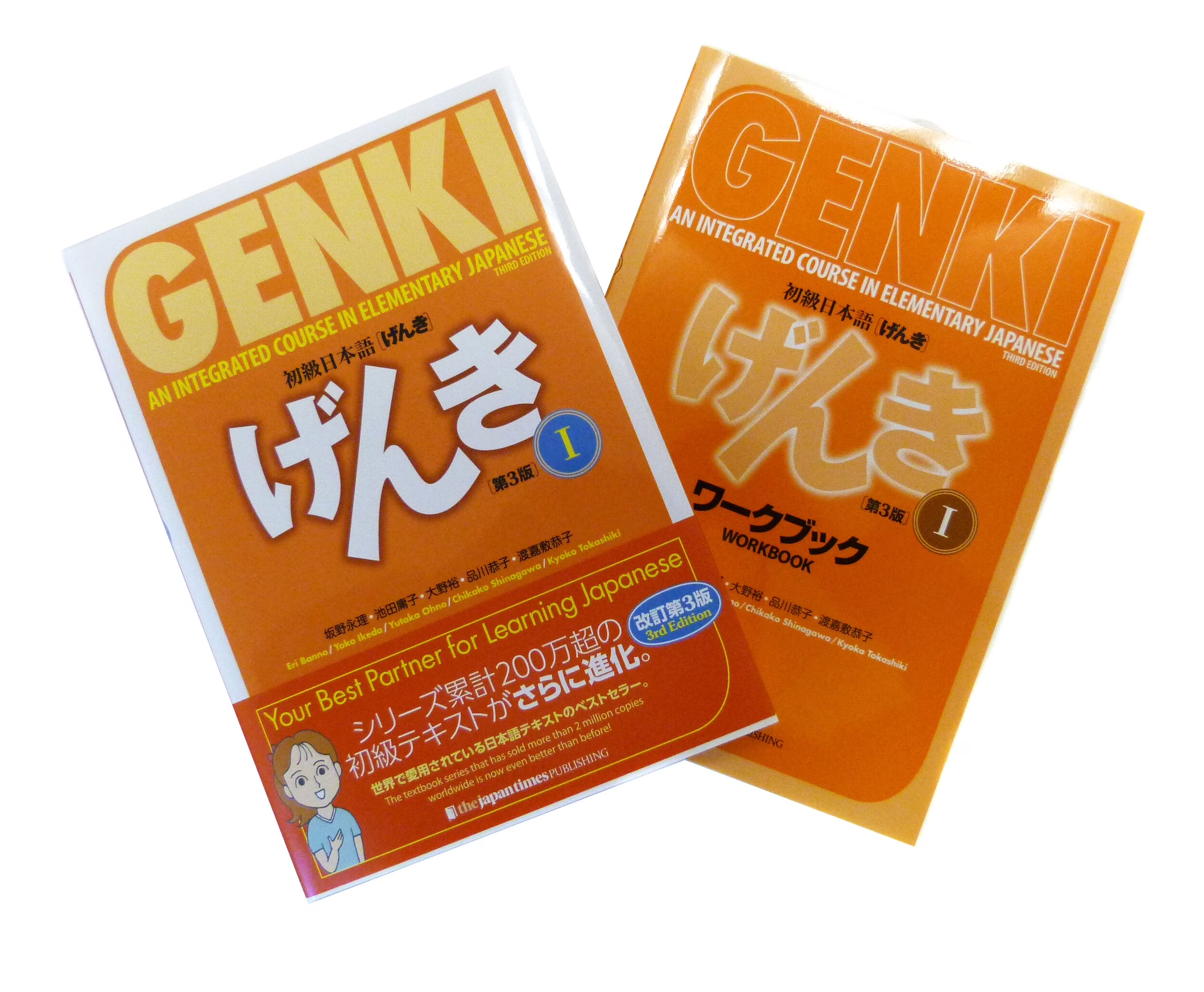
If you want a single recommendation that works for the largest number of learners with the fewest caveats, buy Genki I. It’s the closest thing to a default for English-speaking beginners. It’s not perfect, but it’s solid, structured, and has more supporting resources than any other Japanese textbook in existence.
That said, “the most popular book” and “the best book for you” are two different things. Genki was designed for university classrooms with a teacher present. If you’re learning alone in your kitchen, it might not be your best fit. If you’ve already started with Duolingo or an app, you might want something that doesn’t repeat what you already know. If you’re a complete grammar nerd who wants to understand every rule before practicing it, Genki’s gentle scaffolding will frustrate you.
Read the next section before you click “buy.”
The four Japanese learner archetypes
Most textbook recommendations fail because they pretend learners are interchangeable. They aren’t. Pick the archetype that fits you best and the right textbook becomes obvious.
The self-studier
You’re learning at home, alone, on your own schedule. You don’t have a teacher to explain things, you don’t have classmates to practice with, and you definitely don’t have a Japanese tutor checking your homework. Everything in your textbook needs to be self-explanatory.
What you need is clear English explanations, plenty of example sentences, a built-in answer key for exercises, and audio you can access without jumping through hoops. You also need a book that doesn’t assume you’ll have group activities or pair work, because you won’t.
Best fit: Japanese From Zero (designed for self-study from the ground up) or Genki I with the workbook (most popular, most supplementary resources online) with a full guide by the site.
The classroom learner
You’re enrolled in a Japanese course at a university, community college, language school, or evening program. Your teacher will likely choose your textbook for you, but knowing what they’re working with helps.
What you need is a book your teacher already uses, or one with strong instructor materials. You’ll have someone to explain confusing parts, so you don’t need every nuance spelled out in the book itself.
Best fit: Genki I (used by most North American universities) or Minna no Nihongo (used widely in Japanese language schools and university programs in Japan).
The casual hobbyist
You’re learning Japanese because you love anime, you’re going to Japan next year, you want to read manga, or you just think the language is interesting. You’re not in a rush. You’re not preparing for an exam. You want this to feel rewarding, not like homework.
What you need is a book that’s fun to work through, has cultural context, and doesn’t drown you in grammar drills. You want vocabulary you’ll actually use, not the formal business Japanese you’d need for a Tokyo office.
Best fit: Japanese From Zero (warmest and most beginner-friendly tone) or Tae Kim’s Guide (free, conversational, focused on understanding rather than drilling).
The JLPT-track learner
You have a goal: pass the JLPT at a specific level by a specific date. This is a job requirement, a university admission requirement, or a personal milestone with real stakes. You don’t have time to mess around.
What you need is a book that maps cleanly to JLPT grammar and vocabulary lists, exam-style practice, and a clear path from where you are now to the level you’re targeting.
Best fit: Genki I and II for N5 and N4, Tobira or Quartet for N3, then the Shin Kanzen Master series for N2 and N1. Don’t try to skip the foundation books just because you want to test sooner. You’ll regret it.
Master comparison table
Here’s every major Japanese textbook compared at a glance. Detailed reviews of each follow below.
| Textbook | Level | Best For | Audio | Self-Study Friendly | Approx. Price |
|---|---|---|---|---|---|
| Genki I & II | N5 to N4 | Most learners, classroom or solo | Yes (free download) | Good | $50 to $60 each |
| Minna no Nihongo | N5 to N3 | Classroom learners, Japan-based | Yes (separate purchase) | Hard | $25 to $35 |
| Japanese From Zero | N5 | Pure self-studiers, casual learners | Yes (free, online) | Excellent | $25 each |
| Tae Kim’s Guide | N5 to N3 | Grammar-first self-studiers | No | Good | Free |
| Irodori | N5 to N4 | Adult beginners, JF Standard track | Yes (free, online) | Good | Free |
| Tobira | N3 | Post-Genki, steep challenge | Yes (separate purchase) | Hard | $40 to $50 |
| Quartet I & II | N3 to N2 | Post-Genki, smoother step up | Yes (included) | Better than Tobira | $50 each |
| IAIJ | N3 to N2 | Academic, literary intermediate | Yes | Hard | $45 to $55 |
| Shin Kanzen Master | N3 to N1 | Serious JLPT preparation | Yes | Good | $20 to $30 per book |
| Sou Matome | N3 to N1 | JLPT review at lighter pace | Yes | Excellent | $15 to $25 per book |
Now let’s look at each in detail.
Beginner textbooks (N5 to N4)
Genki I and II
Genki is the most widely used Japanese textbook for English-speaking learners, full stop. Written by a team at the Japan Times, it’s been the default for North American universities for over two decades. The third edition came out in 2020 with updated illustrations, modernized dialogues, and improved audio.
What Genki does well is build skills incrementally without ever feeling overwhelming. Each chapter introduces a manageable chunk of grammar, new vocabulary in themed sets, kanji (漢字, かんじ) one batch at a time, and dialogues you can role-play. The supporting workbook drills everything you’ve learned with reading, writing, and listening practice. Audio is now a free download from the Japan Times website (older editions required a separate CD).
What Genki doesn’t do well is account for solo learners. It’s clearly designed for classroom use. Many activities involve “practice with a partner,” which is useless if you’re alone. Grammar explanations are short and meant to be supplemented by a teacher. If you’re self-studying, you’ll need to fill the gaps with YouTube videos, an app like BunPro, or a grammar reference book.
Best for: university students, classroom learners, and self-studiers who don’t mind supplementing with online resources.
Pair with: the Genki workbook (essential, not optional, despite what some people will tell you), Tokini Andy’s free YouTube playlist that walks through every chapter, and BunPro for grammar drilling.
Minna no Nihongo
If Genki is the North American default, Minna no Nihongo is the Japan default. It’s used in language schools across Japan and in many university programs. The series is denser than Genki, covering more vocabulary and grammar in the same number of chapters.
The catch is that the main textbook is entirely in Japanese. You buy a separate “Translation and Grammatical Notes” companion book in your native language. This setup is intentional. It forces you to engage with Japanese from page one. It also means it’s unforgiving for total beginners working alone.
Pacing is the other big difference. By the end of Minna no Nihongo I, you’ve covered roughly the same ground as Genki I, but with more vocabulary along the way. Minna no Nihongo II takes you noticeably further than Genki II.
Best for: classroom learners (especially in Japan), faster learners who want more density per chapter, and anyone planning to study at a Japanese language school.
Skip if: you’re a pure self-studier and want everything explained in English on the same page.
Japanese From Zero
Japanese From Zero (JFZ) was built specifically for self-studiers. It’s friendly, conversational, and starts with no assumptions. The first book uses romaji extensively, with Japanese script (hiragana and katakana) gradually replacing it as the books progress. That makes JFZ the most beginner-friendly book on this list.
Author George Trombley also has a free YouTube channel walking through every chapter of every book in the series. JFZ is the only major Japanese textbook with a built-in video instructor included at no extra cost.
What it lacks compared to Genki is depth and pacing. JFZ takes longer to cover the same ground. By the end of JFZ Book 3, you’ve covered roughly what Genki I covers. That’s not necessarily bad if you’re learning casually, but it’s slower if you want to reach intermediate quickly.
Best for: complete beginners learning solo, casual hobbyists, and anyone who has tried other textbooks and bounced off them.
Tae Kim’s Guide to Learning Japanese
Tae Kim’s Guide is free, online, and beloved by a particular kind of learner: the one who wants to understand grammar deeply rather than memorize set phrases. It explains Japanese grammar from a Japanese perspective, not by mapping it onto English categories.
This is its strength and its weakness. If you’re the kind of person who hates being told “just memorize this for now,” Tae Kim is for you. If you want structured exercises, vocabulary lists, and a clear “do this then that” path, you’ll find Tae Kim disorienting. There are no exercises. There are no chapters with neat boundaries. It’s a grammar reference dressed up as a guide.
Best for: grammar-curious self-studiers, learners who want a free option, and people supplementing another textbook with a different perspective on tricky grammar.
Irodori
Irodori (いろどり) is a relatively new free textbook published by the Japan Foundation. It’s specifically designed for adult learners living in Japan, with a focus on practical communication for daily life and work situations. All materials, including audio and a workbook, are free PDFs from the Japan Foundation website.
Irodori maps to the JF Standard for Japanese Language Education, which aligns roughly with JLPT N5 and N4. If you’re an adult who’s actually moving to Japan or already living there, Irodori is more practical than Genki for your real-life situations: opening a bank account, calling your landlord, talking to your child’s school.
Best for: adult learners in or moving to Japan, learners who want a free structured option, and anyone whose Japanese needs are practical rather than academic.
Intermediate textbooks (N3 to N2)
After you finish Genki II or its equivalent, you face the intermediate cliff. There’s no Genki III. The textbooks aimed at intermediate learners are noticeably harder, denser, and offer less hand-holding. This is normal. It’s also where most learners quit.
Tobira
Tobira (とびら) bridges the gap from late N4 to early N2. The full title is “Tobira: Gateway to Advanced Japanese.” Each chapter centers on a topic of cultural or social interest in Japan, with reading passages, vocabulary, grammar points, and discussion questions.
Tobira is famously challenging. The reading passages are dense, the grammar explanations expect you to already know your particles cold, and the vocabulary load per chapter is heavy. It’s also one of the most respected intermediate books on the market for exactly that reason. If you finish it, you’ve genuinely earned your intermediate stripes.
Best for: disciplined intermediate learners, JLPT N3 and N2 candidates, learners coming straight out of Genki II who want a serious step up.
Skip if: you want a smoother transition. Quartet is friendlier.
Tobira vs Quartet: The Definitive Intermediate Textbook Comparison
Quartet I and II
Quartet was designed by a team that included some of the same people who wrote Genki, and it shows. The pacing, the structure, and even the visual design feel like a direct continuation of Genki. If you finished Genki II and want the gentlest possible transition into intermediate Japanese, Quartet is it.
Quartet covers four skills (reading, writing, listening, speaking) in each chapter, hence the name. It’s split into two books that together cover roughly N3 and the easier end of N2. Audio comes with the textbook directly, no separate CD purchase needed.
The trade-off is depth. Quartet is more accessible than Tobira but covers slightly less ground. Some learners use Quartet first, then Tobira, to get both the smooth transition and the rigorous content.
Best for: post-Genki learners who want continuity, JLPT N3-track learners, and anyone who found Tobira too steep.
You can view our comprehensive Tobira vs Quartet guide here.
An Integrated Approach to Intermediate Japanese (IAIJ)
IAIJ is the older, more academic option for intermediate Japanese. It’s used in many university intermediate courses in North America. The reading passages skew literary and historical, with topics like Japanese mythology, classical literature, and post-war social issues.
Compared to Tobira and Quartet, IAIJ feels more old-school: less colorful, denser text, more grammar-rule-focused. If you came up through Genki and you’re craving something that feels like a “real” academic textbook rather than a friendly course companion, IAIJ delivers.
Best for: university students, learners who prefer literary content over pop-cultural topics, and anyone supplementing Tobira or Quartet with a third resource.
Upper-intermediate to advanced (N2 to N1)
By the time you’re targeting N2 or N1, general-purpose textbooks become less useful. You want exam-specific preparation. Two series dominate this space.
Shin Kanzen Master
Shin Kanzen Master (新完全マスター, しんかんぜんマスター) is the rigorous choice. Each level has separate books for grammar, reading, listening, vocabulary, and kanji. Buy the books for the skills you need to drill the most.
The grammar books in particular are considered the gold standard for JLPT preparation. They explain each grammar point with multiple example sentences, then drill it with exam-style questions. If you’re targeting a high score (not just a pass), Shin Kanzen Master is the series to use.
Best for: serious JLPT candidates, learners who want depth, and anyone targeting N2 or N1 with stakes attached (job requirement, university admission, immigration).
Sou Matome
Sou Matome (総まとめ, そうまとめ) is the lighter alternative. Each book in the series follows a six-to-eight week structure with daily lessons. It’s friendlier, less dense, and ideal if you’re prepping for the JLPT alongside a full-time job or other commitments.
The trade-off is that Sou Matome covers less ground than Shin Kanzen Master at the same level. If you barely passed your last JLPT level and want a comfortable review, Sou Matome works. If you’re aiming for a high N2 score on your first attempt, you’ll want Shin Kanzen Master.
Best for: time-pressed learners, JLPT review (not first-time learning), and anyone who finds Shin Kanzen Master too dense.
Reference books worth owning
These aren’t textbooks in the traditional sense, but they’re books you’ll consult constantly once you start moving past beginner.
A Dictionary of Basic / Intermediate / Advanced Japanese Grammar
This three-volume set by Seiichi Makino and Michio Tsutsui is the most-cited Japanese grammar reference among serious learners. Each entry includes a detailed explanation, example sentences, common mistakes, and notes on related grammar points. It’s the book serious learners reach for when their textbook’s three-line explanation isn’t enough.
You don’t need all three volumes at once. Buy Basic when you finish Genki I, Intermediate when you start Tobira or Quartet, and Advanced if you cross into N2 territory.
Best for: anyone past the beginner stage who wants real grammar depth.
What about going textbook-free?
Plenty of learners skip textbooks entirely. They pair a free grammar resource (Tae Kim, BunPro) with a vocabulary tool (WaniKani for kanji, Anki for general vocabulary) and as much native input as they can handle, starting with graded readers and progressing to real Japanese media.
This works. It also requires more discipline than a textbook path. Without the structure of “do chapter 3, then do chapter 4,” it’s easy to spin in place, drilling kanji forever without ever practicing grammar in context.
If you’re the kind of learner who has finished other self-directed projects (a coding course, a fitness program, learning an instrument) without external accountability, the textbook-free path can be faster and cheaper. If you’ve started and abandoned three online courses in the last two years, get a textbook. The structure matters more than the specific book.
How to choose: a decision framework
If you’ve read this far and you’re still stuck, here’s the shortest possible decision flow.
- You’re a total beginner, learning solo, no teacher: Buy Japanese From Zero Book 1. Use the free YouTube companion videos. When you finish Book 3, switch to Genki II.
- You’re a total beginner, in a class, or starting one soon: Buy whatever your teacher uses. If you’re picking yourself, buy Genki I. Add the workbook.
- You finished a beginner book and want intermediate: Buy Quartet I for the smoother transition or Tobira if you want a steeper challenge. Pair either with A Dictionary of Intermediate Japanese Grammar.
- You’re prepping for the JLPT specifically: Use Genki for N5 and N4, Quartet or Tobira for N3, then add Shin Kanzen Master books for the skills you’re weakest in (grammar and reading are the usual culprits).
- You hate textbooks: Try Tae Kim’s Guide plus BunPro plus a graded reader series. Set a calendar reminder to check in with your progress every 30 days.
The best Japanese textbook is the one you’ll actually finish. Buy something. Start tomorrow. You can always switch books later if it’s not working, and you’ll have learned more in three months of imperfect study than three years of researching the perfect path.
Frequently asked questions
What’s the best Japanese textbook for absolute beginners?
For most absolute beginners learning solo, Japanese From Zero Book 1 is the friendliest entry point. For beginners in a class or planning to take one, Genki I is the standard. Both will get you to comfortable N5 territory if you actually finish them.
Can I learn Japanese from a textbook alone?
You can learn grammar and reading skills from a textbook alone. You cannot develop confident speaking and listening from a textbook alone. Pair any textbook with audio practice (the included CDs or downloads, plus podcasts or graded listening), and ideally find a tutor or language exchange partner once you reach late N4 territory.
How long does it take to finish Genki I?
A college student doing it as a course finishes Genki I in one semester (about 15 weeks) at roughly 4 to 6 hours of study per week. A self-studier doing 30 minutes a day can finish in three to four months. Going faster than that without a teacher usually means you’re skimming, not learning. Check our guide for how long it takes to finish Genki I.
Is Minna no Nihongo better than Genki?
Minna no Nihongo is denser and covers more material per chapter, which makes it better for fast learners and worse for total beginners going solo. Genki is more beginner-friendly with English explanations on the same page. Most English-speaking self-studiers do better with Genki.
Should I buy the Genki workbook?
Yes. The workbook is where you actually drill what you learned in the textbook. Without it, you’ll passively read the textbook chapter and forget half of it within a week. The workbook is roughly $25 and worth every dollar.
What comes after Genki II?
Quartet I for the smoothest continuation, Tobira for a more challenging step up, or Integrated Approach to Intermediate Japanese for a more academic option. All three target the same N3 range. Check out our guide for what to do after finishing Genki 2.
Are free Japanese textbooks like Tae Kim and Irodori good enough?
For grammar fundamentals, yes. Both will get you to a solid N4 level with discipline. They lack the polish, the structured exercises, and the integrated audio of paid options like Genki, but they’re genuinely usable for serious self-study.
Which Japanese textbook is best for the JLPT?
Genki I and II for N5 and N4. Quartet or Tobira for N3. Shin Kanzen Master series for N2 and N1, supplemented with Sou Matome if you want lighter review. The official JLPT site at jlpt.jp lists what each level expects, which helps you target your prep.
What to do next
Pick one book. Order it today. Open it tomorrow. The single biggest predictor of whether you’ll learn Japanese is not which textbook you chose, but whether you actually opened it consistently for the next six months.
The best Japanese textbook is the one already on your desk. Get one there.