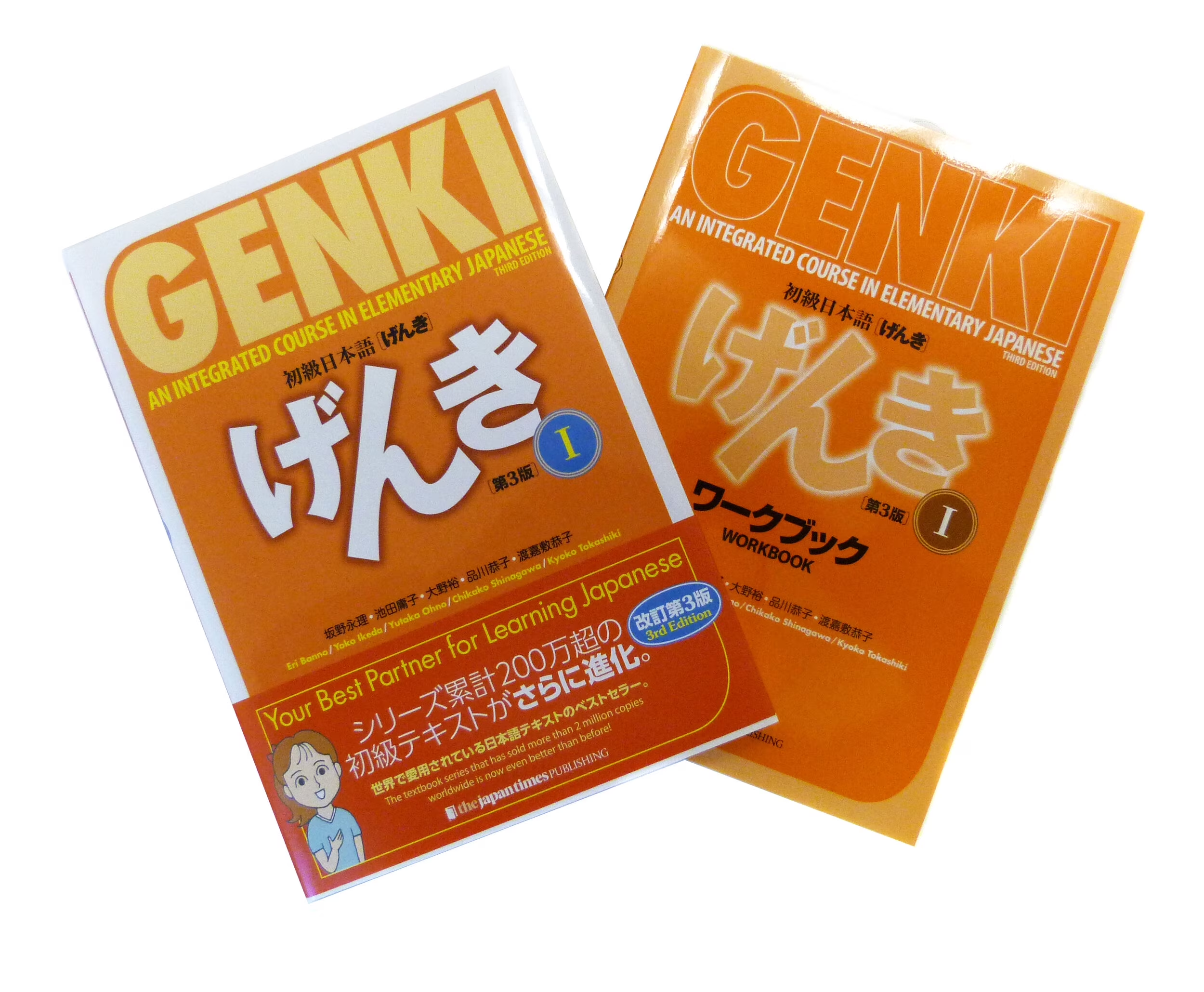
Genki is the most recommended Japanese textbook for English speakers. It’s also a textbook designed for university classrooms, written for students who have a teacher, classmates, and a structured curriculum around it. If you’re sitting at home with the book open and no one to ask “wait, what does this particle do here?” you’ve already noticed the gap.
This isn’t a reason to abandon Genki. It’s the right book for most beginners and the supporting ecosystem around it (YouTube companion courses, app integrations, online communities) is bigger than for any other Japanese textbook. But you need to use it differently than a classroom student would. That means skipping certain exercises, substituting others, and adding tools the book itself doesn’t include.
Here’s the chapter-by-chapter method that actually works when you’re studying Japanese alone.
Table of Contents
What Genki gets right (and what it doesn’t) for self-study
Genki’s strengths are real. Grammar explanations are short but accurate. Vocabulary is presented in themed sets you can actually remember. Dialogues use natural sentence patterns instead of contrived textbook Japanese. The workbook is well-designed for drilling. Audio quality is good and (in the third edition) free to download from the Japan Times site.
What Genki was not built for:
Pair work. Many activities in the textbook are explicit “practice with a partner” tasks. You don’t have a partner. Roughly 20 to 30 percent of every chapter’s exercises assume one.
Self-assessment. The textbook itself doesn’t include an answer key for most exercises. The workbook does, but the textbook expects a teacher to mark your work.
Speaking output. There’s no built-in mechanism for actually opening your mouth and producing Japanese. Reading and listening to dialogues is not the same as speaking.
Grammar depth. Explanations are deliberately compact because they’re meant to be supplemented by a teacher elaborating in class. As a solo learner you’ll sometimes hit a grammar point and feel the explanation is too thin to actually understand it.
The good news: every one of these gaps has a known solution. The bad news: you have to assemble the solutions yourself, because Genki won’t tell you about them.
What you actually need before opening Chapter 1
Don’t start Chapter 1 until you have all of this in place. Trying to add tools mid-stream is how people stall.
Genki 1, third edition textbook and workbook. Get both. The workbook isn’t optional for self-studiers, despite what some people will tell you. The textbook teaches; the workbook is where you actually drill until it sticks. Buying just the textbook is the single most common Genki self-study mistake.
The free Tokini Andy YouTube playlist. Andrew (Tokini Andy) walks through every chapter of Genki 1 and 2 in detailed video lessons that act as your “teacher” filling in the grammar gaps. Watch the corresponding video at the start of each chapter, before you read the chapter yourself. This single change makes Genki roughly twice as effective for self-study and costs you nothing.
An SRS for grammar drilling. BunPro has built-in Genki paths that match the order of the textbook chapter by chapter. As you complete each Genki chapter, you unlock the corresponding BunPro grammar review queue. This is how the grammar actually moves from “I sort of remember this” to “I can use this without thinking.”
An SRS for vocabulary and kanji. Either Anki with the Kaishi 1.5k deck (free, more control) or WaniKani (paid, more structure). Genki’s vocabulary alone is not enough to read or watch anything outside the textbook. We compare the two paths in Best Anki Deck for Japanese Beginners 2026.
Hiragana and katakana already learned. Genki Chapter 1 assumes you already know both kana. Don’t try to learn them inside Genki, learn them in the week before you open the book. Tofugu’s free hiragana and katakana guides take most people two to seven days.
Optional but worth it from Chapter 6 onward: an italki tutor for 30 minutes a week. The earlier you start speaking, the less awkward it will feel later. We cover this trade-off in AI vs Human Tutor for Japanese.
That’s the full stack. Don’t add anything else until you’ve actually used what’s on this list for at least three chapters.
The chapter routine that works for solo learners
Each Genki chapter takes most self-studiers two to three weeks at five hours of study per week. Going faster than that usually means you’re skimming, not learning. Going slower usually means you’re perfectionist-stalling.
Here’s the order that works. It looks like a lot, but most of it is short.
Day 1: Orientation (45 to 60 minutes)
Watch the Tokini Andy video for the chapter before you read anything in the book itself. Take light notes on the grammar points. Don’t try to memorize anything yet. The goal is to know what’s coming so the textbook reading goes faster.
Then read the chapter’s vocabulary list once aloud. Don’t drill it yet. Just expose yourself to the words.
Days 2 to 4: Vocabulary front-loading (20 to 30 minutes per day)
Add the chapter’s vocabulary to your Anki deck or, if you’re using WaniKani, just confirm the WaniKani vocab is keeping pace. Do 10 to 15 new cards a day. Review whatever’s already in your queue.
This is the single biggest change from how Genki was written. The book introduces vocabulary inside dialogues and expects you to learn it in context. That works in a classroom with weekly tests. For self-study, you need vocabulary in an SRS or you’ll forget half of it.
Days 5 to 7: Grammar deep work (40 to 60 minutes per day)
Now actually read the grammar section of the textbook. The Tokini Andy video already gave you the overview, so the textbook explanations will click faster. Do the practice exercises in the textbook (skipping the pair-work ones, more on that below).
At the end of each grammar point, add the corresponding BunPro grammar item to your queue. BunPro’s drilling is where the grammar moves from “I just read this” to “I actually own this.”
Days 8 to 10: Workbook (30 to 40 minutes per day)
Now hit the workbook. This is the part most self-studiers skip and it’s exactly why their Genki progress feels shallow. The workbook is where you actually produce Japanese instead of just recognizing it. Do the listening sections too, even though they feel hard, especially because they feel hard.
Check your answers against the answer key at the back of the workbook.
Days 11 to 14: Consolidation (30 minutes per day)
Re-read the chapter’s dialogue. Read it out loud. Shadow the audio. Do any workbook sections you skipped. Run your BunPro and Anki reviews. If anything still feels shaky, this is the week to fix it before moving on.
If you have an italki tutor, schedule a session in this window. Use the chapter’s grammar points and vocabulary in your conversation. This is where the textbook material moves from passive knowledge to active use.
End of cycle: Quick self-check.
Before moving to the next chapter, ask yourself: can I produce three sentences right now using each grammar point from this chapter, without looking at the book? If yes, move on. If no, don’t re-do the chapter. Just keep BunPro and Anki reviews running and start the next chapter anyway. The grammar from each chapter reinforces itself across the next few chapters automatically.
What to skip, what to substitute, what to add
Most chapter-by-chapter advice for Genki tells you to do everything in the book. As a self-studier, that’s wasted effort. Here’s the honest version.
Skip outright:
- Any exercise marked as pair work where the instruction is “ask your partner” or “interview your classmates.” There’s no useful substitute. Just skip them.
- The “Culture Note” sections, unless you find them genuinely interesting. They won’t make or break your Japanese.
- Re-reading the chapter dialogue more than twice. Diminishing returns kick in fast.
Substitute:
- Pair-work speaking exercises: replace with one of two options. Either record yourself doing both sides of the dialogue (yes, it feels weird; do it anyway) or save the activity for an italki session where your tutor can play the partner role.
- “Practice with a partner using these prompts” exercises: write out full sentences in your notebook instead. Production matters. Doing it solo costs you the conversation practice but keeps the output benefit.
- Listening exercises where you “discuss the answer with a classmate”: just check your own answer against the answer key.
Add:
- BunPro for each grammar point as you reach it.
- An Anki or WaniKani new-card session for the chapter’s vocabulary.
- A 10-minute shadowing session using the chapter’s main dialogue. Play the audio, repeat each line a half-second behind the speaker, matching intonation.
- One short writing exercise per chapter. Write three to five original sentences using the new grammar. Doesn’t matter if they’re correct. The act of producing them is the point.
The four most common self-study failure modes
These are the four ways Genki self-studiers usually quit or stall. Recognize them before they happen to you.
Failure mode 1: Reading without producing. You read the textbook, you watch the Tokini Andy video, you maybe even skim the workbook. You feel like you’re studying. You’re not. You’re consuming. Producing Japanese (writing it, saying it, recalling it from blank) is what builds actual skill. If your study sessions don’t include any active recall, change the routine today.
Failure mode 2: Skipping the workbook. The textbook teaches. The workbook is where it sticks. People skip the workbook because it feels less interesting than learning new material. Then they get to Chapter 8 and discover their Chapter 3 grammar has evaporated. We cover this specifically in Genki Workbook: Do You Actually Need It for Self-Study.
Failure mode 3: Perfectionism stalling. You don’t move on from a chapter until you’ve “mastered” it. Three months later you’re still on Chapter 4. Genki was designed for one chapter per one to two weeks in a classroom. Self-studiers should aim for two to three weeks per chapter and move on whether you feel ready or not. The grammar comes back in later chapters. BunPro and Anki keep it alive. Move forward.
Failure mode 4: Ignoring kanji. Genki introduces kanji slowly and gently. About 90 kanji across the whole of Genki 1. That is nowhere near enough to read native Japanese. If you’re not running a separate kanji track (WaniKani or Anki) alongside Genki, you’ll finish Genki 1 and discover you still can’t read anything. We cover the kanji situation in detail in What to Do After Finishing Genki 1.
How long should each chapter take?
At roughly five hours of study per week, two to three weeks per chapter is the realistic range. That puts Genki 1 at a completion time of six to eight months for most self-studiers.
If you have more time (10 to 12 hours per week), you can compress to one to two weeks per chapter and finish in three to four months. We break down realistic timelines in How Long Does It Take to Finish Genki 1.
Going faster than one chapter per week without a teacher almost always means you’re cutting the workbook or skipping the SRS drilling. That looks like progress for a few weeks until the unreinforced material falls out of memory and you have to backtrack. Don’t optimize for speed. Optimize for what you’ll still remember six months later.
When you finish Genki 1
You’ll be sitting at solid JLPT N5 territory: about 300 vocabulary words, the basic grammar of polite speech, and around 90 kanji. You can introduce yourself, describe your day, shop in simple Japanese, and read a tourist phrasebook.
You cannot yet hold a real conversation, read manga, or understand fast native speech. That’s expected. Genki 1 is a foundation, not a finish line.
The path from here depends on your goal. Full breakdown in What to Do After Finishing Genki 1. The short version: start Genki 2 immediately, keep the kanji track running, and consider adding a weekly italki session if you haven’t already.
For a wider view of how Genki compares to every other Japanese textbook, see Best Japanese Textbook: Every Option Compared.
Where to start tomorrow
If you don’t have Genki 1 and the workbook yet, order both today. If you do, the next step is short: bookmark the Tokini Andy Chapter 1 video, sign up for BunPro’s free tier, and set up your Anki or WaniKani account. That’s the full Day 1 setup.
Then open Chapter 1 tomorrow. The single biggest predictor of whether you’ll learn Japanese with Genki isn’t your study system. It’s whether you actually open the book consistently for the next six to eight months.
Everything in this guide is a tool to make that consistency easier. Use what helps. Skip what doesn’t. Keep moving.