Tobira vs Quartet…Which Intermediate Textbook Is Right for You?
The community debate between Tobira (とびら) and Quartet (カルテット) produces a lot of heat and not much light. You’ll find passionate advocates for both books in every Japanese learning forum, and if you read enough threads you’ll come away more confused than when you started.
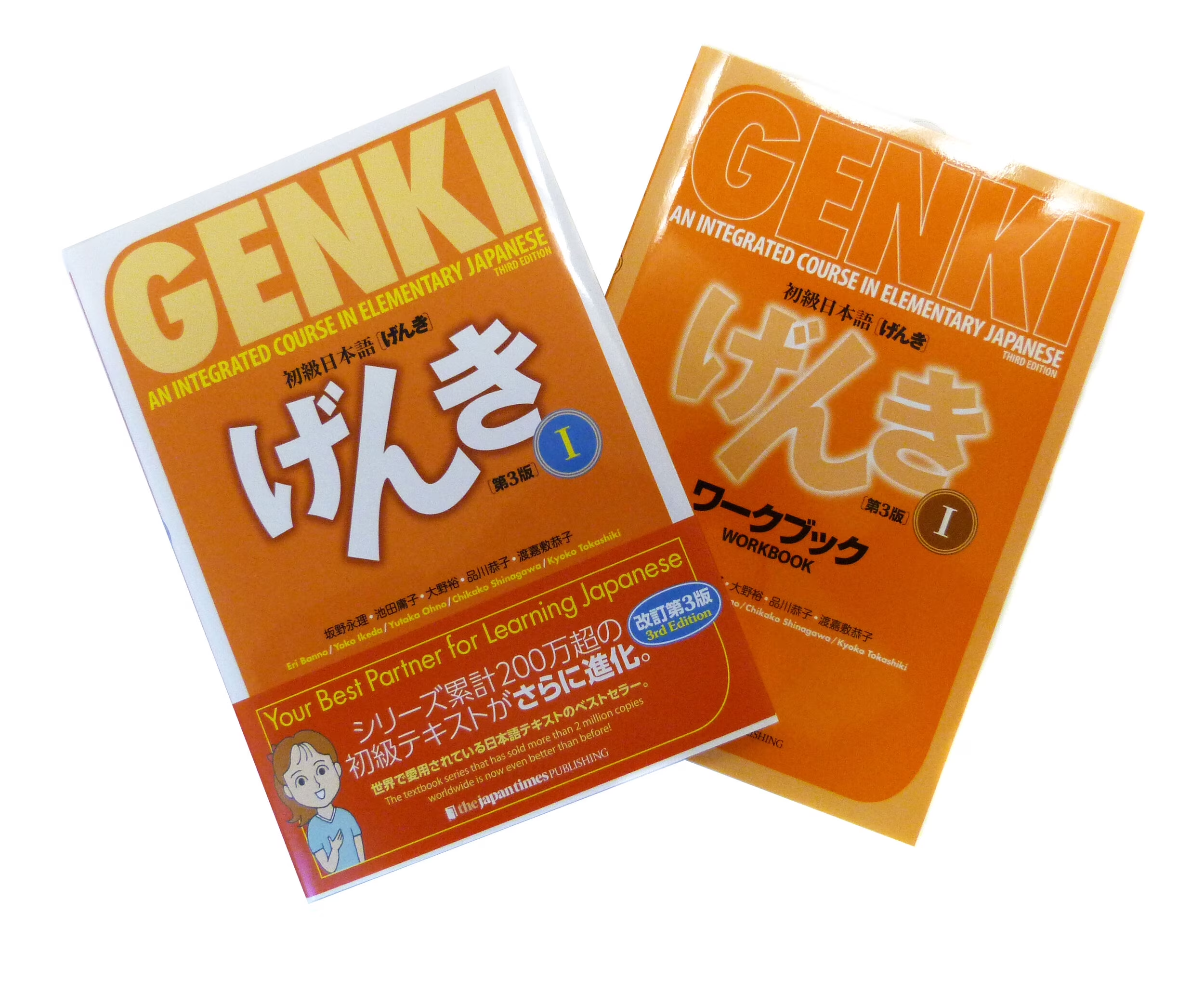
That’s partly because most comparisons miss the actual point. Tobira (とびら) and Quartet (カルテット) are not competing for the same learner. They overlap in level (both pick up where Genki II leaves off) but they prioritize different things, and the one that suits you depends heavily on how you study, what you’re studying for, and what frustrated you about Genki in the first place.
This comparison covers both books properly: structure, grammar coverage, reading content, self-study suitability, JLPT (日本語能力試験, にほんごのうりょくしけん) alignment, and a direct verdict by learner type. By the end you’ll know which one to buy, and more importantly: why.
Table of Contents
1. Who These Books Are For
Both Tobira and Quartet are intermediate Japanese textbooks designed to follow Genki II or an equivalent N4-level foundation. Neither is a beginner book in disguise, and neither is a JLPT cram book. They are structured courses designed to carry you from solid N4 through most of N3, with Tobira(とびら) extending somewhat further toward N2.
If you have not finished Genki II or its equivalent, neither book is the right move yet. Both assume you’re already comfortable with て-form conjugations, basic particles, plain form, and the fundamental grammar structures covered in N5–N4 material. Starting either book without that foundation means spending most of your time confused rather than learning.
[Link to: What to Do After Finishing Genki 2]
2. Book Structure and Layout
Tobira: Gateway to Advanced Japanese
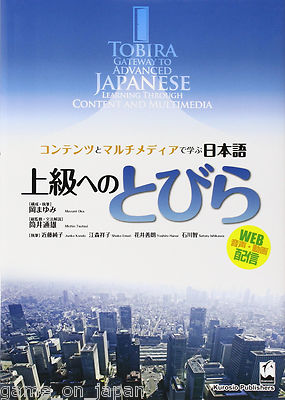
Tobira (とびら) was published in 2009 by Kurosio Publishers and has been the default post-Genki recommendation in university Japanese programs for well over a decade. The main textbook has fifteen chapters organized around thematic content: Japanese society, technology, history, the environment. Each chapter is built around a central reading passage.
The layout is text-heavy and entirely in Japanese). There are no English grammar explanations in the main textbook. Grammar points are introduced through example sentences and usage notes in Japanese, with English translations provided for the example sentences but not for the explanatory text itself.
This is a deliberate pedagogical choice. Tobira is designed to push you into processing the language rather than translating it. It works, but it also means the first few chapters feel significantly harder than the Genki chapters you’re used to, even when the grammar content is objectively not that much more advanced.
Quartet: Intermediate Japanese Course
Quartet (カルテット) was published in 2018 by the Japan Foundation. It is a significantly newer book, and it shows. The design is cleaner, the layout is less dense, and the chapter structure is more immediately approachable for self-studiers accustomed to modern textbook conventions.
Quartet has two volumes of eight chapters each, for sixteen chapters total. Each chapter is organized around a theme and built around both dialogue and reading content, with grammar points introduced in English and then drilled through exercises. The grammar explanations use English, which is a meaningful difference from Tobira for learners who find the fully-Japanese explanations of the latter book slow going.
The companion Quartet Workbook covers writing and listening practice and is designed to be used alongside each chapter of the main text.
3. Grammar Coverage
Both books cover the N4–N3 grammar range, but they approach it differently.
Tobira covers approximately 120–130 grammar patterns across its fifteen chapters. Coverage skews toward the higher end of N3 and dips into N2 territory in the later chapters, making it useful for learners with JLPT N2 in their sights. The grammar explanations are nuanced. Tobira doesn’t just tell you what a pattern means, it shows you how it behaves in different contexts and what distinguishes it from similar patterns. That nuance is valuable but requires active engagement to get the benefit.
Quartet covers a similar number of grammar patterns but distributes them more evenly across the N4 – N3 range. It doesn’t push as deep into N2 territory as Tobira. The explanations are clearer and more accessible but occasionally sacrifice nuance for simplicity. You get the rule without always getting the edge cases, typically. For most learners at this level that trade-off is reasonable; the edge cases can be picked up through reading and SRS later.
One thing both books share: grammar encountered once per chapter fades fast without review. So try to review the grammar points often and ideally via an SRS program.
4. Reading and Vocabulary
This is where the two books diverge most noticeably.
Tobira’s reading passages are long, substantive, and written in authentic Japanese) on genuinely interesting topics. By Chapter 4 or 5 you’re reading multi-paragraph texts on subjects like the Japanese education system, environmental issues, and cultural identity. The vocabulary load per chapter is high. 30 – 50 new words is not unusual, and the reading difficulty increases steadily across the fifteen chapters.
This makes Tobira genuinely good preparation for reading native material. The jump from Tobira Chapter 15 to real newspapers or essays is real but manageable. The jump from Genki II to those same materials is not.
Quartet’s reading content is more varied in format. There are shorter passages, dialogues, and mixed-media content sit alongside longer texts. The vocabulary load per chapter is more controlled, which is easier on learners who find Tobira’s pace overwhelming. The downside is that Quartet’s reading passages don’t build the same sustained reading stamina that Tobira’s longer texts develop.
If reading ability is your priority, especially if you want to eventually read native books, newspapers, or manga without heavy support, Tobira’s reading content is the stronger preparation.
5. Self-Study Suitability
This is the comparison most forum discussions get wrong, because both books are routinely described as “good for self-study” without qualification.
Tobira can absolutely be used for self-study, and many people do. But it demands more from the self-studier than Genki did. The all-Japanese grammar explanations mean you need to work harder to confirm your understanding of a new pattern, and the speaking/dialogue exercises designed for classroom use don’t adapt as naturally to solo practice. The official Tobira website provides supplementary audio and some additional resources, which helps.
Self-study with Tobira works best if you’re already comfortable learning from Japanese-only explanations, have some way to check your grammar understanding (a tutor, a language exchange partner, SRS, etc), and are genuinely motivated by the content of the reading passages.
Quartet is more accommodating for self-studiers. English grammar explanations mean you spend less time decoding the instructions and more time learning the content. The workbook covers listening practice clearly. The chapter structure is predictable enough that you can build a consistent weekly routine around it without constantly having to figure out what to do next.
For self-studiers without access to a classroom or tutor, Quartet is the more manageable choice from a practical standpoint, even if Tobira is the stronger book on paper.
6. JLPT Alignment
If you’re studying for a specific JLPT level, this does matter actually.
Tobira maps well to JLPT N3 and N2 preparation. The grammar patterns it covers overlap substantially with N3 and lower N2 exam content, and the reading passages develop the sustained comprehension needed for the N2 reading section. Finishing Tobira( and supplementing with a dedicated prep series like Shin Kanzen Master puts you in a strong position for N2.
Quartet aligns more cleanly with N3 preparation. Its grammar coverage is solid for N3 but doesn’t extend as meaningfully into N2 territory. Learners targeting N3 specifically will find Quartet an efficient path to exam readiness. Those targeting N2 will likely need more supplementary material after finishing Quartet than after finishing Tobira.
7. The Companion Materials
Tobira’s ecosystem
- Tobira Grammar Pattern Exercises: Supplementary drilling for the grammar points in each chapter. Useful, but sold separately and adds to the cost.
- Tobira website: Free audio, vocabulary lists, and some additional exercises. Better than nothing; not a replacement for the workbook.
- No official workbook equivalent to Genki’s, though the Grammar Pattern Exercises book fills part of that role.
Quartet’s ecosystem
- Quartet Workbook: Covers listening and writing practice chapter by chapter. More closely integrated with the main textbook than Tobira’s supplementary materials.
- Two-volume structure means costs spread across both books if you purchase as you go.
- Newer publication means fewer third-party resources, Anki decks, and study guides compared to Tobira’s established ecosystem.
The practical upside of Tobira’s age is community resources: vocabulary Anki decks, chapter-by-chapter study guides, and forum threads with answers to almost every question you’ll encounter are all widely available. Quartet’s community resources are thinner, though improving as adoption grows.
8. Side-by-Side Summary
| Tobira (とびら) | Quartet (カルテット) | |
|---|---|---|
| Publisher | Kurosio Publishers (2009) | Japan Foundation (2018) |
| Chapters | 15 | 16 (8 per volume) |
| Grammar explanations | Japanese only | English and Japanese |
| Reading content | Long, substantive passages | Varied formats, shorter passages |
| Vocabulary load | High | Moderate, more controlled |
| Self-study accessibility | Moderate. Demands more from the learner | High. More accommodating |
| JLPT alignment | N3 and N2 | N3 primarily |
| Companion workbook | Grammar Pattern Exercises (separate) | Workbook (separate) |
| Community resources | Extensive | Growing but thinner |
| Price (approx.) | ~$55 – 65 for main text | ~$45 – 55 per volume |
9. Verdict by Learner Type
Choose Tobira (とびら) if:
- You’re targeting JLPT N2 and want a single textbook that gets you most of the way there
- Reading native material is your primary long-term goal
- You’re comfortable learning grammar from Japanese-only explanations, or have a tutor or language partner to check your understanding
- You want access to an established community of learners with extensive supplementary resources
Choose Quartet (カルテット) if:
- You’re targeting JLPT N3 and want a clean, efficient path to that level
- You’re a self-studier who found Genki’s format comfortable and wants something that continues that energy
- English grammar explanations are important to you. You want to be confident you understand a pattern before drilling it
- The modern layout and varied content formats suit how your brain processes new material
The case for using both: Some learners use Quartet for the core grammar coverage, benefiting from its accessible explanations, and then move to Tobira for the reading-heavy later chapters to build stamina before native materials. That’s not a standard recommendation, but it’s a legitimate path if budget isn’t a constraint and your primary frustration with Genki was its slow reading development.
The case for neither: If your grammar is solid and your main bottleneck is vocabulary and kanji, another textbook may not be your most efficient next move. A dedicated kanji SRS like WaniKani plus a gramma) SRS like BunPro, combined with graded reading like Satori Reader, can take you to N3 without a textbook at all. That’s a less structured path but a legitimate one for self-directed learners who find textbook pacing frustrating.
Can I use Tobira or Quartet without finishing Genki 2?
Not comfortably. Both books assume N4-level grammar as a starting point. If you’ve finished Genki 1 but not Genki 2, or used an equivalent resource that covered N5 but not N4, you’ll spend most of your time in either book confused rather than learning. Finish Genki 2 or its equivalent first.
Is Tobira harder than Quartet?
In terms of grammar difficulty, they’re comparable at the N3 level. Tobira feels harder in practice because of the all-Japanese explanations and the dense reading passages…but that difficulty is partly by design. You’re being asked to process more of the language rather than translate it. Quartet feels more immediately accessible but isn’t covering fundamentally easier material at the N3 level.
Do I need the workbook/companion materials?
For Quartet: the workbook is worth having. The listening exercises in particular don’t have a clean free equivalent.
For Tobira: the Grammar Pattern Exercises book is useful for drilling but not strictly required if you’re running BunPro alongside the main text. The main Tobira textbook alone is workable for self-studiers with a grammar SRS habit.
How long does each book take to finish?
Tobira: at one chapter per week, fifteen weeks, roughly four months. Realistically, five to six months for a working adult, since the later chapters are noticeably longer.
Quartet: sixteen chapters across two volumes, so similar overall, four to six months depending on pace and how thoroughly you work through each chapter.
Which book do Japanese universities use?
Tobira is by far the more common choice in university Japanese programs globally, partly because of its age and partly because its reading-heavy approach suits academic language goals. Quartet is a newer addition to university syllabi and gaining adoption, particularly in programs affiliated with the Japan Foundation.
The right choice between Tobira and Quartet) isn’t about which book is objectively better. It’s about which one matches how you actually study, what you’re studying for, and how much friction you’re willing to accept in exchange for depth. Both will carry you competently from N4 to N3. What happens after that depends as much on what you do alongside the textbook as which textbook you chose.
Finished up Genki 1? Check out What to Do After Finishing Genki 1 if you’re curious.
Wondering about which is the best overall textbook for Japanese? Check out our article about the best Japanese textbook for more info!