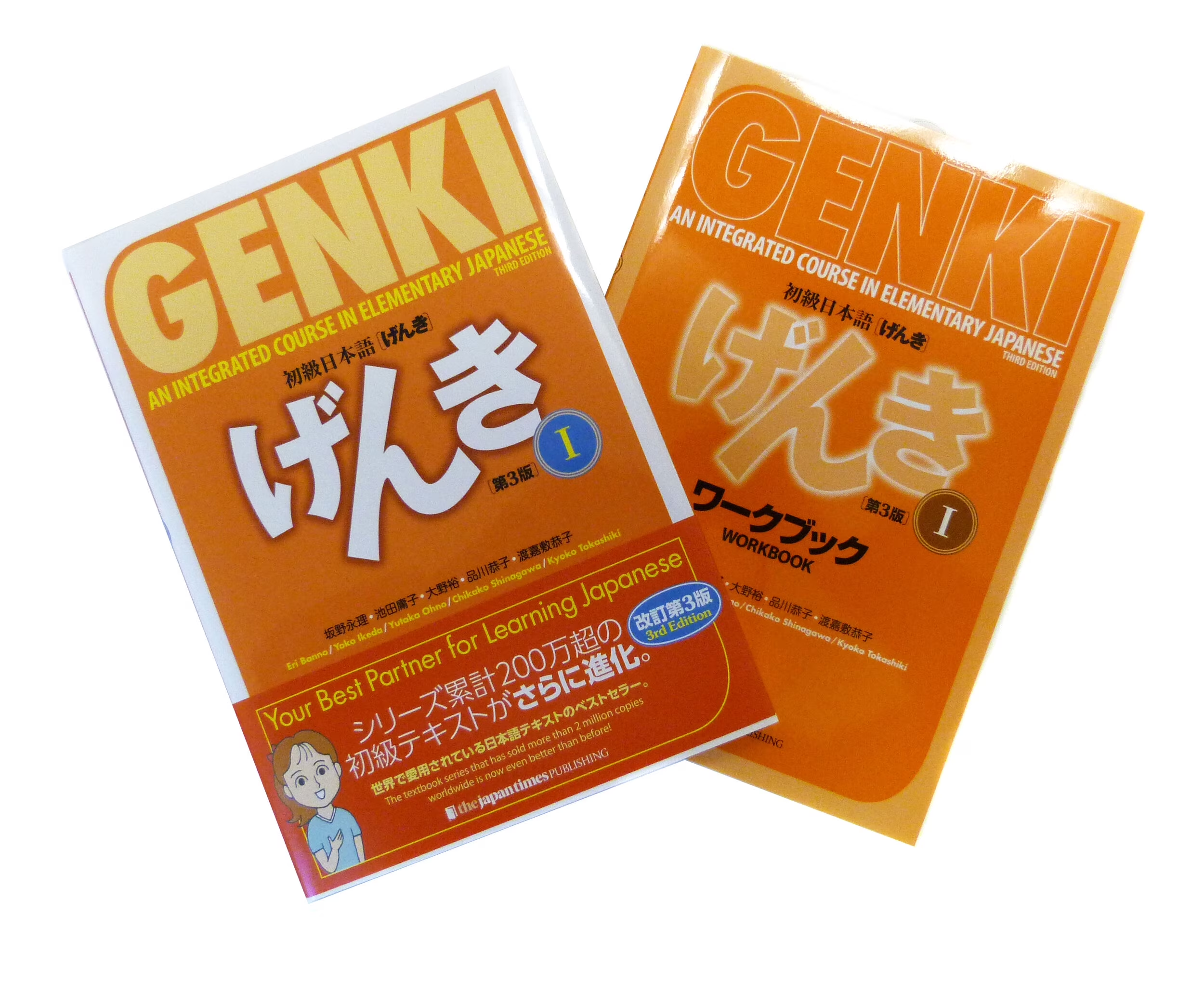
What to Do After Finishing Genki 1: Clear Next Steps for Self-Studiers
You closed Genki 1 for the last time (congrats, by the way!) You worked through the workbook, drilled the dialogues, and got through all twelve chapters. And now you’re staring at a gap you didn’t expect.
You know hiragana, katakana, and somewhere around 300 words of Japanese 日本語 (にほんご). You can build basic sentences. But if you’ve tried watching an anime episode, reading a real text, or even understanding a slow native speaker, you already know the uncomfortable truth: finishing Genki 1 doesn’t mean you can actually use the language. Not even close.
This is not a sign you’ve been doing something wrong. It means you’ve completed a structured beginner course, and what comes after Genki 1 is genuinely less clear because it depends entirely on what you want to do with Japanese.
Here’s how to figure out your path.
Want to know how long it should have taken? Check out our guide on How Long Does It Take to Finish Genki 1
Table of Contents
Where You Actually Stand After Finishing Genki 1
Genki 1 covers roughly JLPT N5 content: around 300 vocabulary words, both kana syllabaries, and the first 90 or so Kanji 漢字 (かんじ). You can handle self-introductions, shopping, telling the time, and describing your day in simple sentences.
What you cannot do yet: understand fast native speech, read anything beyond a tourist phrasebook, or hold a conversation longer than two minutes without hitting an unknown word.
That’s not a criticism. Genki 1 was designed for university classrooms running roughly 150 contact hours of guided instruction. If you self-studied through it, you’ve done something the majority of beginners never finish. The problem is that Genki 1 gives you a controlled, scaffolded environment. Real Japanese use is messier and more personal.
The right next step after Genki 1 depends on what you actually want. Someone targeting JLPT N4 in six months needs a different plan than someone who just wants to enjoy watching dramas.
Your Goal Decides What Comes Next

Goal 1: Pass JLPT N4 (or N3)
If you have a concrete exam target, the path is the most structured of the three options here.
For the next three months: Work through Genki 2. It directly covers the grammar and vocab you need for N4, and it picks up exactly where Genki 1 left off.
Pair it with BunPro for grammar SRS. BunPro organizes N5 and N4 grammar points into a spaced-repetition review system, so the patterns you study actually stick instead of fading after you close the textbook. The free tier is enough to get started; the paid tier adds cram mode and detailed grammar-path controls that become useful once you’re deep into N4 material.
For Kanji: N4 requires around 300 kanji. WaniKani will eventually get you well past that, but it moves on its own schedule and won’t align neatly with Genki 2’s vocabulary. If exam prep is your immediate goal, Anki with an N4 kanji deck gives you more direct control over what you’re studying and when.
After Genki 2 and N4: You’ll be standing in front of the N3 wall, and you’ll need to decide between Tobira and Quartet as your next textbook. We compare them in detail in Tobira vs Quartet: Which Intermediate Japanese Textbook Is Right for You.
Goal 2: Get Conversational

Here’s the uncomfortable reality for this path: no textbook will make you conversational on its own. Textbooks teach you structure. Speaking forces that structure into your brain through real communicative pressure.
Start speaking before you feel ready. Most learners at this level wait until they feel “prepared enough.” That moment doesn’t arrive on its own. At N5 level you understand maybe 30 to 40 percent of what a patient tutor says to you. That discomfort is the mechanism, not a sign you need to study more first.
italki is the most practical option for regular conversation practice. You can find Japanese tutors who specialize in absolute beginners, book 30-minute sessions, and use them to consolidate the grammar you’re studying in Genki 2. Even one session per week makes a significant difference to how quickly structures become automatic.
Keep working through Genki 2 for grammatical scaffolding. But treat the textbook as a support structure for your speaking practice, not a prerequisite to it.
Also: build a daily listening habit with material slightly above your current level. The Nihongo con Teppei for Beginners podcast is well-calibrated for late-N5 to early-N4 learners. You won’t understand most of it at first. That’s fine. Repeated low-stakes exposure builds listening comprehension 聴解 (ちょうかい) faster than any workbook exercise.
Check out Nihongo con Teppei here!
Goal 3: Read Manga or Watch Anime in Japanese

This path has a sequencing problem that trips up almost everyone: people try to jump from Genki 1 directly into native manga or anime, find it incomprehensible, and either give up or develop a very slow reading habit that depends entirely on looking up every other word.
The smarter move is a two-step bridge.
Step one: graded readers: The White Rabbit Press graded readers at Level 0 and Level 1 are calibrated almost exactly for where you are after Genki 1. They use simple sentence structures with all kanji glossed. They’re not exciting, but they build reading fluency at a level where you’re actually reading rather than decoding. Skipping this step and going straight to manga is like trying to run before you can walk consistently.
Step two: Yomitan: Get this browser extension set up before you try reading anything online. Yomitan is a pop-up dictionary that lets you hover over any kanji on a web page to get the reading and definition instantly. It changes what reading practice feels like at this level.
For manga specifically: Yotsuba&! (よつばと!) is the standard entry-level recommendation and it earns that reputation. It uses casual conversational Japanese, simple vocabulary, and furigana on most kanji. It’s readable at your current level with Yomitan open. Plan to start it around the halfway point of Genki 2 rather than right now.
For anime: raw listening is genuinely out of reach until you have significantly more vocabulary. Watching with Japanese subtitles and Yomitan in a browser player is more useful than English subtitles from a study standpoint, but it requires the reading speed to keep up, which takes time to build.
The Thing Nobody Tells You After Genki 1: Kanji
Regardless of which path you’re on, kanji will be your bottleneck.
Genki 1 introduces around 90 kanji. Reading native Japanese text fluently requires somewhere between 2,000 and 3,000. You are not close to that number, and the further you go in Japanese without building a real kanji foundation, the more painful everything else becomes. Grammar study stalls. Vocabulary doesn’t stick. Reading feels like code-breaking.
Two practical options after Genki 1:
WaniKani is the most structured kanji system available for self-studiers. It uses mnemonics and SRS to teach roughly 2,000 kanji and 6,000 vocabulary words across 60 levels. Consistent users reach Level 20 (enough for basic native reading) in around six to eight months. The pacing is deliberately slow at first to ensure retention. The free trial covers Levels 1 to 3; the lifetime subscription is expensive upfront but pays off if you use it for the 18 to 24 months the full course realistically takes.
Anki with a structured deck is the faster-paced, self-directed alternative. The Kaishi 1.5k deck is the current community recommendation and it’s better structured than the older Core 2k deck it replaced. You control the pacing, which is both the advantage and the risk. Adding new cards too aggressively is the most common way people end up with 300 daily reviews they can’t keep up with. We cover the deck choice in detail in Best Anki Deck for Japanese Beginners 2026, and the optimal review settings in Anki Japanese Settings: The Optimal Setup Guide.
If you’re exam-focused, Anki gives you direct control over which kanji you prioritize. If you want a system that manages itself, WaniKani is harder to derail. For a deeper comparison see WaniKani vs RTK: An Honest Comparison and WaniKani vs jpdb.io: Which Kanji SRS Is Right for You.
Pick one. Don’t try both simultaneously.
Check out our article on WaniKani vs. RTK here or our article on WaniKani vs. jpdb.io here!
Genki 2: Start It Now or Wait?
Start it now.
Genki 2 picks up directly from Genki 1 and covers the grammar patterns you need for N4. There’s no clean way around it if you want to reach conversational or exam-ready Japanese at any reasonable pace. Waiting until you feel ready is just a way of delaying the inevitable while your Genki 1 retention gradually fades.
One thing to avoid: treating Genki 2 as a prerequisite to everything else. A lot of self-studiers make the mistake of working through the textbook alone, chapter by chapter, before touching any other resource. That produces the plateau most people hit around the N4 to N3 boundary, where they know a lot of grammar rules but can’t produce or understand natural Japanese.
Study Genki 2 while also building kanji, doing listening practice, and either reading graded materials or speaking with tutors. The textbook is scaffolding, not the whole building.
After Genki 2, the two main options are:
Tobira: Gateway to Advanced Japanese is the long-standing recommendation for the transition to upper-intermediate study. It uses authentic texts from the first chapter, the vocabulary is noticeably harder than Genki 2, and the jump in difficulty feels real. It was designed with classroom use in mind, which means the teacher’s guide is excellent but the self-study experience requires more patience.
Quartet 1 is the newer alternative, increasingly preferred by self-studiers. The layout is cleaner, the grammar explanations are more intuitive for learners working alone, and the progression feels more deliberate. It’s worth comparing both before buying.
Neither is wrong. The one you’ll actually open regularly is better than the one sitting untouched on your shelf. If you’re not sure which to buy, Tobira vs Quartet: Which Intermediate Japanese Textbook Is Right for You walks through the decision in detail. For a wider view of every textbook on the market, see Best Japanese Textbook: Every Option Compared.
A Realistic Weekly Schedule After Genki 1
This is what a sustainable post-Genki 1 week looks like at roughly five hours total. Adjust for your own schedule, but keep the daily Anki or kanji reviews as the non-negotiable item.
| Day | Activity | Time |
|---|---|---|
| Monday | Genki 2: new grammar chapter + workbook | 40 min |
| Tuesday | Anki or WaniKani reviews + new cards | 20 min |
| Wednesday | Listening practice (podcast or one drama scene) | 30 min |
| Thursday | Anki or WaniKani reviews only | 15 min |
| Friday | Genki 2: reading section + vocabulary review | 30 min |
| Saturday | BunPro grammar SRS or speaking session via italki | 30 min |
| Sunday | Graded reader or Yotsuba&! with Yomitan open | 30 min |
The specific activities matter less than the principle behind them: do something in Japanese every single day, even on days when it’s only ten minutes of reviews. Consistency across months outperforms intensity in isolated weekend sessions by a significant margin. The learners who reach fluency in Japanese rarely have the best study plan. They’re usually the ones who kept going long enough for everything to compound.
Is Genki 1 enough to start watching anime without subtitles?
No. Understanding unsupported native audio requires far more vocabulary and listening exposure than Genki 1 provides. With Japanese subtitles and a pop-up dictionary, you can make slow, effortful progress through simple slice-of-life anime around mid-N4 level. Watching for pure enjoyment with English subtitles is completely fine at any stage, but that’s entertainment, not study. Set realistic expectations: raw anime comprehension is a late-N3 to N2 goal for most learners.
How long does Genki 2 take to finish for a self-studier?
At a similar pace to Genki 1, expect three to six months depending on how many hours per week you study. Genki 2 has twelve chapters comparable in density to Genki 1. If you finished Genki 1 in four months at roughly five hours per week, Genki 2 will take roughly the same.
Do I need to review all of Genki 1 before starting Genki 2?
A focused review of the grammar patterns from Genki 1’s final four or five chapters is worthwhile. Re-reading the whole book is not necessary unless several months have passed and your recall is genuinely patchy. BunPro’s N5 grammar path is actually more efficient for this than re-reading Genki 1, because it surfaces only the specific patterns you’re weakest on rather than asking you to re-read content you already know.
Should I use WaniKani or Anki for kanji after Genki 1?
WaniKani if you want a system that tells you exactly what to study and when, and you’re willing to stay on its schedule for 18 to 24 months. Anki if you want direct control over pacing and don’t mind managing your own decks. The failure mode for WaniKani is abandoning it when the review pile builds in months three to four. The failure mode for Anki is adding too many new cards too fast and drowning in reviews. Know which pattern applies to you.
What if my Genki 1 grammar doesn’t feel solid?
Move forward anyway. Trying to fully master Genki 1 before touching Genki 2 is a procrastination pattern dressed up as diligence. Genki 2 reinforces Genki 1 grammar through new contexts as you progress. Add BunPro for the N5 grammar path and do a short review before starting each new Genki 2 chapter. Imperfect progress beats perfect preparation every time.
Is it worth hiring a tutor at this stage?
Yes, if your goal involves any kind of speaking or listening. A 30-minute weekly session with a patient tutor does more for your actual output ability than an extra hour of textbook work. You’ll be uncomfortable. That discomfort is the point. There is also the choice of finding a language exchange partner or potentially even using AI (shock, gasp) for studying Japanese. For early level learners it’s surprisingly good given that it’s a LLM (large language model). Check out our article on AI as a tutor here!
The next step after finishing Genki 1 is not one answer. It’s a decision shaped by your goal, your timeline, and what kind of study actually keeps you showing up. Pick your path from the options above, get your kanji system in place, and crack open Genki 2 this week.
Everything compounds from there.
Already wondering what comes after Genki 2? See What to Do After Finishing Genki 2. Still shopping for the right post-Genki textbook? Check the full pillar comparison at Best Japanese Textbook: Every Option Compared.