How to Learn Kanji Without WaniKani
WaniKani is not the only way to learn kanji. It’s not even necessarily the best way, it’s just the most marketed one.
There are learners who rule it out because of the price. Others find the fixed curriculum frustrating when the characters they need for their textbook won’t appear in WaniKani for another fifteen levels. Others simply don’t want to be locked into someone else’s learning order for two or three years. All of those are legitimate reasons, and all of them have solutions.
This is a full map of every serious kanji study method that doesn’t involve WaniKani, what each one is, how it works, who it suits, and what it costs.
Table of Contents
1. What You Actually Need to Learn (Before Picking a Method)
Before choosing a method, it helps to be clear about what “learning kanji” actually means, because different methods solve different parts of the problem.
There are three distinct things to learn for each kanji:
Meaning: What concept does this character represent? 火 (ひ) means fire. 水 (みず) means water. 食 (しょく) relates to eating or food.
Readings: How is this character pronounced? Most kanji have at least two readings, an on’yomi (おんよみ) (Chinese-derived reading) and a kun’yomi (くにょみ) (native Japanesereading). The reading that applies depends on context and the word the kanji appears in.
Vocabulary: Which actual words use this kanji, and how does it behave in them? 火 (ひ) alone means fire, but 火曜日 (かようび) means Tuesday and 花火 (はなび) means fireworks. The kanji shifts meaning subtly depending on the word.
Different methods prioritize these three things differently. RTK focuses almost entirely on meaning first. Anki vocabulary decks teach meaning and reading together through words. jpdb.io ties all three to specific content you want to consume. Understanding which combination matters most for your goals is how you pick the right method.
2. Method 1: RTK + Anki (The Fast Recognition Route)
What it is: Remembering the Kanji (usually called RTK) is a book by James Heisig that teaches 2,200 kanji meanings through mnemonics and component analysis. Each kanji gets a single English keyword and a short story connecting its visual components to that keyword. You drill keyword then the Kanji using Anki, a free spaced repetition software.
How it works in practice:
- Work through RTK Volume 1 chapter by chapter, reading Heisig’s mnemonic stories
- Add each kanji to an Anki deck as you go, or use a pre-built RTK Anki deck (freely available on AnkiWeb)
- Review daily
- Finish all 2,200 kanji, then move to readings through vocabulary study
What it does well: RTK is the fastest route to recognizing kanji shapes and recalling their rough meaning. Learners who complete it describe being able to “see through” kanji, to parse any character’s visual structure even if they don’t know its reading. This makes the subsequent step of learning readings through vocabulary significantly faster.
What it doesn’t do: RTK teaches no readings whatsoever. It also teaches no vocabulary, no grammar, and no actual Japanese words. After finishing RTK you cannot read Japanese, you’ve only built the visual recognition layer. Readings and vocabulary come in a separate phase, typically through an Anki vocabulary deck like Kaishi 1.5k or through sentence mining from native content.
Who it suits: Learners who want to build kanji recognition quickly, are comfortable running a parallel grammar and vocabulary study track alongside it, and don’t mind that the payoff, being able to actually read Japanese, is deferred until after completion.
Time: Six to eight weeks at an intensive pace (20+ new kanji/day). Seven to ten months at a sustainable everyday pace (10 new kanji/day).
Cost: RTK Volume 1 costs approximately $25 – 35 on Amazon. Anki is free on desktop and Android; the iOS app is a one-time $25 purchase.
3. Method 2: Anki with the Kaishi 1.5k Deck (Vocabulary-First)
What it is: A free, community-maintained Anki deck covering 1,500 high-frequency Japanese vocabulary words. The current community standard for beginner vocabulary SRS. It replaced the older Core 2k deck that most older guides still recommend, and is better in almost every respect: better example sentences, better audio, better card formatting.
How it works in practice:
- Download Anki and import the Kaishi 1.5k deck (both are free)
- Study 10 – 20 new cards per day, reviewing daily
- Each card shows a vocabulary word with its kanji, reading in hiragana, English meaning, and an example sentence with audio
- Kanji recognition builds naturally as you accumulate vocabulary, you learn 食事 (しょくじ) and 食べる (たべる) and gradually internalize what 食 (しょく) means and how it behaves
What it does well: This method mirrors how kanji actually work in the language, embedded in words rather than studied in isolation. Every card you learn is a real word you can use immediately. The payoff is faster than RTK because you’re building usable vocabulary from day one rather than deferring it.
What it doesn’t do: Without explicit kanji meaning mnemonics, recognizing a kanji outside of words you’ve already studied is harder. Vocabulary-first learners sometimes struggle to parse unfamiliar compounds in a way that RTK graduates don’t, because they haven’t built the component-level visual analysis that RTK drills explicitly.
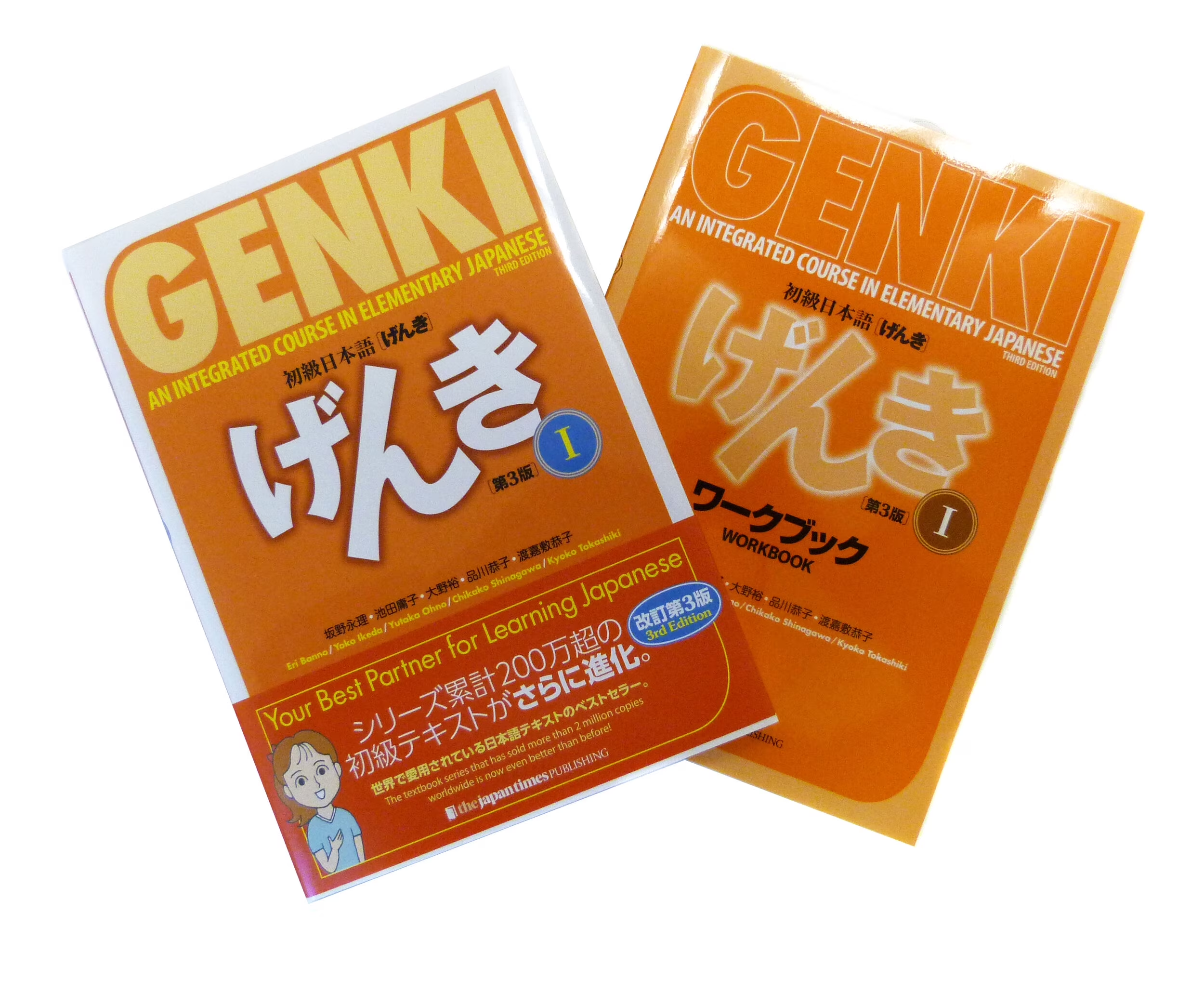
Who it suits: Learners who want immediate, usable results and real words from day one. Works especially well alongside a grammar textbook like Genki, since the deck’s vocabulary overlaps substantially with Genki’s word lists.
Time: The 1,500 cards take roughly four to six months at 10 new cards per day, accounting for review load.
Cost: Completely free! Anki is free on desktop and Android; the Kaishi 1.5k deck is free to download from AnkiWeb.
4. Method 3: jpdb.io (Content-Based SRS)
What it is: A free web-based vocabulary database and SRS with frequency lists derived from thousands of Japanese media titles (anime, manga, visual novels, novels, games, etc) that you know and love. You study vocabulary (and the kanji within those words!) in the order they appear most frequently in specific content you want to consume.
How it works in practice:
- Create a free account on jpdb.io
- Search for a specific title and view its frequency list
- Add those words to your SRS deck in frequency order
- Alternatively, use jpdb’s general frequency list (most common words across all indexed media) as a curriculum-free approach
What it does well: Motivation. Studying vocabulary you’ll immediately encounter in content you’re genuinely interested in is a powerful driver of consistency. There’s also something concrete to point at, specifically working through a specific title’s frequency list feels purposeful in a way that a generic vocabulary deck sometimes doesn’t.
What it doesn’t do: jpdb provides no kanji meaning mnemonics. You’re learning words and their readings, with kanji recognition building implicitly through exposure rather than through structured meaning drilling. For absolute beginners without an existing vocabulary base, the content-specific approach can feel scattered until you’ve built enough foundation to actually engage with the target content.
Who it suits: Intermediate learners already doing immersion study who want their SRS tied directly to native content. Also useful for beginners with a very specific content goal (a particular game or manga series) who want to prepare vocabulary for it specifically.
Cost: Free for core features.
Check out our WaniKani vs jpdb Full Comparison
5. Method 4: KKLC (Kodansha Kanji Learner’s Course)
What it is: The Kodansha Kanji Learner’s Course, usually shortened to KKLC, is a book by Andrew Scott Conning covering 2,300 kanji. It’s the main serious alternative to RTK for learners who want a structured book-based kanji curriculum.
How it differs from RTK:
- KKLC teaches both kanji meanings and readings, unlike RTK Volume 1, which defers readings entirely
- It groups kanji by visual similarity and shared components, making it easier to distinguish similar-looking characters
- Each kanji entry includes example vocabulary words showing the character in real use
- Coverage extends to 2,300 kanji, slightly more than RTK’s 2,200
What it does well: KKLC is arguably a more complete single-resource than RTK Volume 1, because it incorporates readings and vocabulary examples rather than deferring them to a separate study phase. For learners who found RTK’s “meaning only” approach frustrating, KKLC solves that directly.
What it doesn’t do: Like RTK, KKLC is a book, so the SRS drilling has to be done separately with Anki. Pre-built KKLC Anki decks are available on AnkiWeb, though the community resources are thinner than RTK’s. The book is also denser and less beginner-friendly than RTK in its early chapters.
Who it suits: Learners who want the structured, book-based approach of RTK but want readings incorporated from the beginning rather than deferred. Also suits learners who plan to take the JLPT (日本語能力試験, にほんごのうりょくしけん) and want their kanji study to include reading practice from the start.
Time: Similar to RTK, six to twelve months depending on pace.
Cost: Approximately $35-45 on Amazon, plus free Anki for SRS drilling.
6. Method 5: Learning Kanji Through Your Textbook
What it is: Letting your grammar textbook drive your kanji study rather than running a separate kanji system. Genki, for example, introduces around 300 kanji across its two volumes; you study those as they appear, in the context of the grammar and vocabulary of each chapter.
How it works in practice:
- Work through your textbook normally
- Add each new kanji to a simple Anki deck as it appears, with meaning, reading, and an example word
- Review those cards alongside your regular textbook study
- No separate kanji curriculum, no additional resource to manage
What it does well: Simplicity. You’re not running two parallel study systems: kanji study is integrated into what you’re already doing. Every kanji you learn is immediately relevant to the material you’re covering.
What it doesn’t do: Textbooks introduce kanji slowly and in a limited set. Genki’s 300 kanji leave a large gap between finishing both volumes and being able to read standard adult Japanese text, which requires around 2,000 characters. If reading fluency is a goal, textbook-only kanji study will eventually become the bottleneck.
Who it suits: Beginners who want to keep their study as simple as possible and aren’t yet concerned with reading native material. Works well as a starting point; add a dedicated kanji SRS later once the textbook foundation is solid.
Time: Entirely dependent on textbook pace.
Cost: Nothing beyond the textbook you’re already using.
7. Method 6: Writing Practice (The Traditional Approach)
What it is: Learning kanji through repeated handwriting, writing each character multiple times until the stroke order and shape are memorized. This is how kanji has been traditionally taught in Japanese schools.
The honest assessment: As a standalone method for adult self-studiers, pure writing repetition is slow and not well-supported by how memory actually works. Writing a character twenty times in a row produces short-term familiarity, not long-term retention. Without spaced repetition (returning to a character after a day, then three days, then a week) most of what you write is forgotten within days.
Where writing practice does add value: As a supplement to SRS-based study, not a replacement for it. Writing kanji by hand creates a motor memory that recognition-only study doesn’t, and that additional memory pathway can make retention more robust. Some learners find that characters they consistently confused in digital SRS become distinct once they’ve written them by hand.
Who it suits: Learners who need to write Japanese by hand, for academic purposes, professional contexts, or personal preference. For most self-studiers whose primary goal is reading comprehension, the time investment in handwriting practice may not justify the payoff compared to additional SRS time.
Cost: A notebook and a pencil.
8. Which Method Is Right for You?
The right kanji method depends on three things: your current level, your primary goal, and how much friction you can tolerate in your study setup.
If you’re a complete beginner who wants to keep things simple: Start with Anki and the Kaishi 1.5k deck alongside your grammar textbook. It’s free, it’s immediately useful, and it requires no separate curriculum decisions. Add a more structured method later if the kanji gap becomes a bottleneck.
If you want to build kanji recognition fast and don’t mind deferring readings: RTK + Anki is your best option. It’s not the most beginner-friendly setup but it’s the fastest route to being able to parse kanji visually, which makes everything that comes after noticeably easier.
If you want readings incorporated from the beginning: KKLC is the RTK alternative that includes readings and vocabulary examples from the start. Takes longer per kanji than RTK but delivers more complete knowledge per character.
If you’re an intermediate learner doing immersion: jpdb.io. Tie your vocabulary and kanji study to the content you’re actually consuming. The motivation dividend is real and the tool is free.
If you’re studying for the JLPT: KKLC or Kaishi 1.5k Anki, depending on whether you prefer book-based or deck-based study. Both incorporate readings, which RTK doesn’t, and JLPT reading sections require readings, not just meanings.
Check out JLPT Exam Dates 2026: Registration Guide
Can I learn kanji without any SRS at all?
Yes, but it’s significantly slower. SRS (spaced repetition software) is effective for kanji because it solves the core retention problem: without scheduled review, most characters fade within days of first encountering them. High-volume reading can eventually replace SRS as your primary kanji reinforcement mechanism, but that requires a reading level high enough to encounter each character repeatedly in context, which takes time to build.
How many kanji do I need to know to read Japanese comfortably?
The joyo kanji (常用漢字, じょうようかんじ) set, 2,136 characters, is the standard benchmark for adult literacy in Japanese. In practice, knowing around 1,000-1,200 kanji unlocks a significant portion of everyday text, and most learners find comprehension improving noticeably around that point. Full newspaper and novel reading requires closer to the full 2,000+.
Is RTK still worth doing or is it outdated?
RTK’s core method, separating meaning from readings to reduce early cognitive load, is still sound regardless of the book’s age. The main thing that has changed is that the community Anki resources around it are now mature enough that many learners skip the book entirely and use a free Anki RTK deck instead. The method works; the book is optional.
How long does it realistically take to learn all the joyo kanji?
At 10 new kanji per day through any SRS method: roughly seven to nine months for initial learning. Factor in review load maintenance and the occasional reset from life getting in the way, and twelve to eighteen months to genuinely solid retention is a more honest estimate for most learners.
Do I need to learn to write kanji by hand?
For most self-studiers, no, at least not as a primary study activity. Recognition is sufficient for reading and listening comprehension, which covers the majority of Japanese use cases. If you need to write Japanese by hand, for academic exams, professional settings, or personal reasons, add writing practice as a supplement to SRS study rather than instead of it.
What happened to the Core 2k deck that older guides recommend?
The Core 2k/6k deck has been effectively superseded by the Kaishi 1.5k deck, which has better audio, better example sentences, and more active community maintenance. Most older guides and forum posts still reference Core 2k because they were written before Kaishi became the community standard. If you’re starting fresh, use Kaishi 1.5k.
There is no single correct way to learn kanji without WaniKani. RTK is faster for recognition. Kaishi 1.5k builds usable vocabulary from day one. KKLC is more complete per character. jpdb ties everything to content you actually care about. The method you’ll finish is the one you’ll actually do every day, and that depends on your goals, your tolerance for setup complexity, and how motivated you are by the payoff each approach offers.
Have further questions? Check out our WaniKani vs RTK Full Comparison or our WaniKani vs jpdb Full Comparison if you want to know more!