Best Anki Deck for Japanese Beginners 2026
Last updated: April 2026
When you first set up Anki for Japanese, you’ll quickly run into the same problem: AnkiWeb has hundreds of Japanese decks, they all claim to be good, and almost none of them tell you how they were made or why they made the choices they did.
Most beginners end up picking whichever deck shows up first, or whichever one a Reddit thread from four years ago happened to recommend. Both are reasonable guesses that often land on decks that are outdated, inconsistently made, or simply not the best option available anymore.
This is what the community actually uses in 2026, why the recommendations have shifted, and which deck is right for where you are right now.
Table of Contents
What Makes a Good Beginner Deck?
Before getting into specific decks, it helps to know what you’re evaluating. Four things separate a deck worth months of your time from one that will quietly make your study less effective.
Vocabulary selection. A good beginner deck uses frequency data: the words you’ll encounter most often in real Japanese. A bad one uses textbook order, random selection, or outdated frequency lists. Words like 思う (おもう) (to think) and 言う (いう) (to say) should appear near the top. Obscure formal vocabulary that rarely shows up in conversation should not.
Example sentence quality. Cards without sentences teach you to recognize words in isolation, which doesn’t transfer well to reading or listening. Cards with badly written, overly complex, or unnatural sentences can actively teach wrong intuitions. Good sentences make the meaning of the target word obvious without requiring vocabulary far above your current level.
Audio consistency. All native-speaker audio is not equal. Pitch, recording environment, and speaker clarity vary across a deck if different recordings were stitched together from multiple sources. You’re building pronunciation intuitions from audio you hear hundreds of times. Inconsistency matters.
Active maintenance. Japanese itself doesn’t change much, but frequency data, community consensus on which words matter, and the tools Anki uses to display cards do. A deck with an active maintainer fixes errors, updates the template when Anki’s card format changes, and responds when users report problems. A dead deck accumulates unfixed issues indefinitely.
The Top Pick: Kaishi 1.5k
Who it’s for: Anyone starting Japanese vocabulary from scratch in 2026.
Kaishi 1.5k is the current community standard. It was built specifically to replace Core 2k, and it addresses the older deck’s weaknesses directly: the vocabulary comes from a modern frequency corpus, the sentences were written by native speakers for this deck rather than borrowed from other sources, the audio is consistent throughout, and there’s an active maintainer who fixes errors and updates the template.
The “1.5k” in the name means 1,500 cards. That might sound like less than ideal compared to a 2,000-card deck, but the count is deliberate. Kaishi covers the highest-priority vocabulary for a beginner without extending into words you’d be better off learning through sentence mining from native content later.
What each card includes:
- The target word in kanji
- Furigana on the back
- A pitch accent indicator
- An example sentence with furigana
- Audio for both the word and the sentence
Out of the box, Kaishi requires no template editing or add-on fiddling to display correctly. This matters more than it sounds. Many hours have been wasted by beginners wrestling with Core 2k’s card template before they’ve even reviewed their first card.
How long it takes to finish. At 10 new cards per day, you’ll complete Kaishi in about 5 months. At 15 new cards per day, closer to 3.5 months. That assumes you don’t miss days. A realistic estimate with normal life is 5 to 7 months at a sustainable pace.
Download it here: The deck by username “Friedrich” with the orange bird icon is the maintained version. Don’t download forks or mirrors.
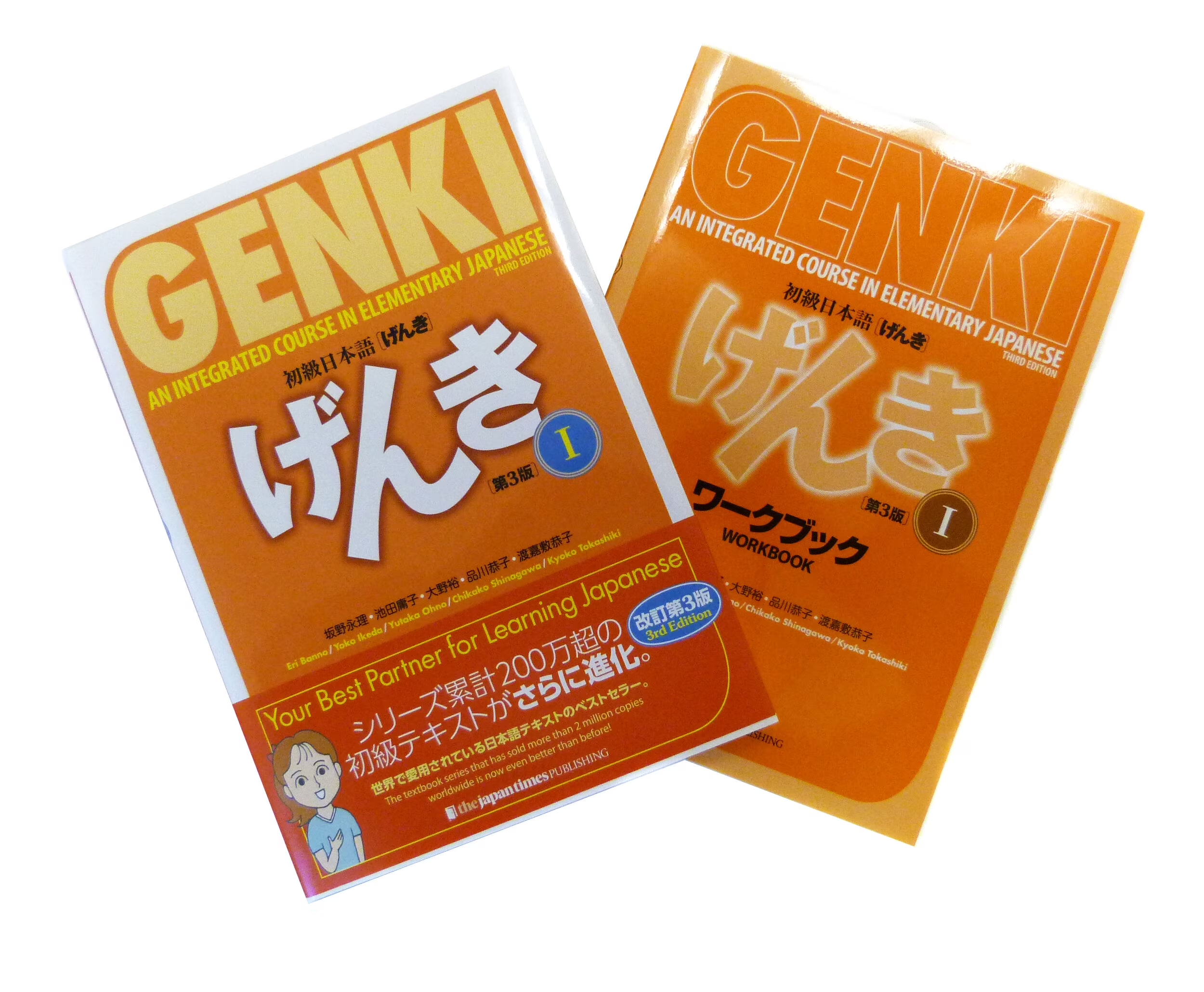
One honest limitation. Kaishi is vocabulary-only. It doesn’t teach grammar, it doesn’t explain particles (は, が, を), and it won’t tell you how to conjugate anything. You need to run a grammar resource alongside it. Genki I is the standard structured choice. Tae Kim’s Guide is free and genuinely good. The deck and the grammar resource work in parallel, not in sequence.
The Legacy Option: Core 2k
Who it’s for: Learners already partway through it with a working habit.
Core 2k was the community recommendation from roughly 2012 to 2022. It’s built from iKnow.jp’s vocabulary database, it covers 2,000 high-frequency words, and it has native-speaker audio. Thousands of people have used it to reach a usable Japanese vocabulary level.
But it has problems that haven’t been fixed and won’t be: vocabulary sourced from formal written Japanese rather than contemporary speech, example sentences that are inconsistent in quality (some excellent, some confusing), occasional audio quality issues, and no active maintainer.
The case for Core 2k today is narrow. If you’ve already done 300 or more reviews with a stable habit, switching to Kaishi means restarting the FSRS scheduler’s memory model for those cards, disrupting a habit that’s working, and re-learning words you already know. The problems with Core 2k are real but not severe enough to justify that disruption if you’re already moving. You can download Core 2k here.
If you’re at zero, pick Kaishi. If you’re mid-deck with momentum, stay the course.
For a full breakdown of what specifically changed between the two decks, read our side-by-side comparison of vocabulary selection, sentence quality, audio, and maintenance status.
The JLPT-Aligned Option: Tango N5
Who it’s for: Learners whose primary short-term goal is passing the JLPT N5.
The Tango series (Tango N5, Tango N4, etc.) organizes vocabulary by JLPT level. Each card is a sentence rather than an isolated word, which means you’re studying grammar and vocabulary simultaneously from the start.
The Tango N5 deck covers around 800 words, which is roughly what N5 requires. Cards are sentence-based, with the target word bolded in context. Audio is included. Check out Tango N5 here.
Where it works well: If you’re explicitly studying for the N5 exam in the next three to six months, Tango N5 is more directly aligned to the test than Kaishi. You won’t overshoot the vocabulary threshold or spend time on words the test doesn’t assess.
Where it falls short: The sentence-card format, while good for comprehension in principle, is harder to study when you’re still building foundational vocabulary. When the sentence contains five words you don’t know and one you’re supposed to be learning, you’re solving a reading problem rather than learning vocabulary. Sentence mining works best when you can already parse most of a sentence except the target word. For most N5 learners, that condition isn’t met yet.
The verdict: if you’re specifically targeting N5 and have a test date on the calendar, Tango N5 is worth considering. If you’re learning Japanese broadly, Kaishi 1.5k will serve you better over the long run because it covers significantly more vocabulary once you move past N5 territory.
The Recognition-First Option: RRTK
Who it’s for: Learners who want to recognize kanji shapes before learning full vocabulary.
RRTK (Recognition RTK) is not a vocabulary deck. It’s a kanji recognition deck based on the Remembering the Kanji method. Each card teaches you to recognize a kanji by associating it with a keyword and a mnemonic. You learn what 木 means (tree) and how to distinguish it from 本 (book/origin) before you encounter them in vocabulary.
The appeal is reducing the cognitive load of early vocabulary study. When you first see 木曜日(もくようび) (Thursday), you already know 木 is tree, 曜 is weekday, and 日 is day/sun. That prior recognition makes the compound easier to remember.
The honest case for RRTK: Some learners find that pre-learning kanji recognition dramatically speeds up vocabulary acquisition. The immersion-learning community (AJATT, Refold) has historically recommended doing a recognition pass on common kanji before starting a vocabulary deck.
The honest case against it: RRTK takes 1 to 3 months to complete at a reasonable pace. That’s 1 to 3 months before you learn any vocabulary that makes Japanese comprehensible. Most learners lose motivation during this period because there’s no payoff in actual comprehension. You can distinguish 木 from 本, but you can’t read a single sentence or understand a word of spoken Japanese.
The community has split on this. Kaishi 1.5k’s approach, teaching vocabulary in context with example sentences, handles kanji recognition as a byproduct rather than a prerequisite. Most beginners do better starting with Kaishi and picking up kanji recognition gradually.
If you want to go the kanji-first route, WaniKani is a more structured and better-supported alternative to RRTK. It teaches kanji in a specific pedagogical order with full spaced repetition built in, and it’s purpose-built for this use case. You should check out WaniKani vs Anki for Kanji that we made for this site.
Decks to Skip
A few decks show up consistently in search results and deserve a direct note.
Core 6k / Core 10k. Extensions of Core 2k that cover 6,000 and 10,000 words respectively. The same quality issues apply, amplified. At 10,000 cards, the proportion of words you’ll encounter rarely in everyday Japanese becomes significant. Vocabulary above 6,000 is almost always better learned through sentence mining from native content rather than pre-built decks.
Heisig RTK (Remembering the Kanji) Anki deck. The full RTK method teaches all 2,200 joyo(常用) kanji with English keywords and invented mnemonics but deliberately excludes readings. This has generated intense debate for decades. The core problem for most learners: spending months learning to write and identify kanji without being able to read any Japanese. If you’re specifically interested in handwriting, RTK has value. For reading and listening comprehension, it’s a long detour.
Random community decks with no stated frequency corpus. AnkiWeb has many Japanese decks built by individuals for personal use and shared publicly. Some are excellent. Most are not. Without a stated vocabulary source, you have no way to evaluate whether the word selection is high-frequency or arbitrary. Stick to decks with documented methodology.
Duolingo’s exported vocabulary lists. Several decks on AnkiWeb export Duolingo’s Japanese course vocabulary into Anki card format. Duolingo’s vocabulary selection is not frequency-based. It’s organized around Duolingo’s own lesson structure, which prioritizes words that fit their exercise formats over words you’ll actually encounter most in Japanese.
How to Set Up Whichever Deck You Choose
Before you review your first card, open your deck options and set these three things.
New cards per day: 10. Not 15. Not 20. Every card you add today creates a review obligation that compounds for months. Ten new cards per day across 5 months gets you through Kaishi 1.5k with a daily review load you can realistically maintain alongside grammar study. Starting at 20 per day sounds faster but almost always results in a review pile that kills the habit within two months.
Maximum reviews per day: 9999. Don’t cap your reviews. Capping them defers cards to the next day, which makes tomorrow’s pile larger. If your reviews are out of control, the fix is stopping new cards temporarily, not hiding the backlog behind a limit.
Algorithm: FSRS. Enable FSRS in your deck options and set desired retention to 0.85. FSRS is the modern Anki algorithm and it’s better than the default in every measurable way: more accurate scheduling, fewer unnecessary reviews, and no ease hell. It’s been built into Anki natively since 2023.
For the full settings walkthrough, including learning steps, leech thresholds, and the font fix that stops Anki from showing Chinese character variants for Japanese kanji check out our guide.
FAQ
What is the best Anki deck for Japanese beginners in 2026?
Kaishi 1.5k. It’s the current community standard, built with a modern frequency corpus, native-speaker sentences written for the deck, consistent audio, and active maintenance.
Is Core 2k still good for Japanese?
If you’re starting from scratch, no. Kaishi 1.5k is better in every measurable way. If you’re already several hundred reviews into Core 2k with a working daily habit, finish it. The problems with Core 2k are real but not severe enough to justify restarting mid-deck.
How many cards per day should I do as a beginner?
Start at 10 new cards per day. This is the number most experienced Anki users land on after learning through painful experience what happens when they start at 20 or 30. Review debt compounds silently and then becomes overwhelming around the two-month mark. Start conservative, prove the habit is stable for four to six weeks, then consider increasing if you genuinely want to.
Do I need Anki if I’m using WaniKani?
Not necessarily, but they serve different purposes. WaniKani teaches kanji and vocabulary through a fixed, curated order with spaced repetition built into the platform. Anki is a flexible SRS tool that lets you study anything, including vocabulary from content you’re consuming. Many learners use WaniKani for kanji and a separate Anki deck for vocabulary, or switch to Anki entirely once they want to mine vocabulary from native material. Neither is wrong.
Should I use Anki at all, or just use another app?
Anki requires more setup than apps like Duolingo or JapanesePod101, but it’s more effective for building the large vocabulary base Japanese requires. Japanese has a high vocabulary threshold for comprehension: you need roughly 6,000 to 10,000 words to understand most everyday content, compared to around 3,000 to 5,000 for European languages. Anki’s spaced repetition is designed for exactly this kind of large-scale vocabulary retention. Apps with gamified interfaces tend to review vocabulary less efficiently. If you want to reach reading and listening comprehension in Japanese, Anki is worth the setup cost. There is also a case to be made for choosing to augment your learning with an AI tutor.
What should I do after finishing Kaishi 1.5k?
Start mining vocabulary from native content. By the time you finish Kaishi, you’ll have around 1,500 known words, which is enough to start reading beginner manga and some graded readers with a dictionary. Install Yomitan as a browser extension, connect it to Anki through AnkiConnect, and start adding words you encounter in content you’re actually consuming. That transition, from curated decks to personal mining decks, is when Anki stops feeling like homework and starts feeling like a natural part of immersion.
The short version: if you’re starting Japanese vocabulary from zero in 2026, download Kaishi 1.5k, set your new cards to 10 per day, enable FSRS, and open a grammar resource alongside it. That’s the setup.
Everything else in this article covers the edge cases: what to do if you’re already in Core 2k, whether a kanji-first approach is worth it, which JLPT-specific deck to consider if you have a test date. If none of those apply to you, you have everything you need.
Once the deck is running, the settings underneath it matter more than most beginners expect. The optimal Anki settings guide for Japanese learners covers every option that affects how many reviews you’ll see, how quickly cards graduate, and whether your habit survives the first two months.