You’re watching anime with subtitles and a thought creeps in: am I actually picking up Japanese right now? Maybe I could just… watch more?
The Quick Answer: Yes, you can learn Japanese from anime, but not by watching passively. Anime builds listening exposure and vocabulary memory. It won’t teach you grammar or how to read. The learners who succeeded with anime were also using textbooks and flashcard apps alongside it. Used as a supplement to structured study, it’s genuinely effective.
Table of Contents
What Anime Actually Teaches You (And What It Doesn’t)
Anime does a few things genuinely well for language learners. This is consistent across language learning communities: ask anyone who’s reached conversational Japanese how they stayed motivated through the first year, and anime comes up in nearly every answer.
What anime can do:
- Train your ear to the sounds and rhythm of Japanese
- Expose you to vocabulary in emotional, memorable contexts (you’re far more likely to remember a word heard during a tense fight scene than one on a flashcard)
- Build listening speed over time
- Keep you motivated when studying feels like a grind
What anime cannot do:
- Teach you grammar. Watching Dragon Ball Z will not explain verb conjugations to you.
- Teach you to read. Japanese is written in three separate scripts, and anime gives you zero reading practice unless you watch with Japanese subtitles.
- Give you polite or professional Japanese. Most anime dialogue is extremely casual, sometimes rough, and occasionally completely made up (fantasy settings, exaggerated speech patterns, sound effects that are not real words).
- Replace structured vocabulary study. Picking up words from context works, but it’s slow and unreliable at beginner level.
The honest summary: anime builds listening exposure and motivation. It does almost nothing for grammar, reading, or formal language. If those are the gaps in your study plan, anime alone won’t fill them.
The Problem with Relying on Anime Alone
There’s a theory in language learning called comprehensible input, developed by linguistics researcher Stephen Krashen. The core idea: you acquire language naturally when you understand roughly 95% or more of what you’re hearing. The content sits slightly above your current level, but not so far above that it becomes noise.
Vocabulary researcher Paul Nation puts a harder number on this. His frequency studies found that readers and listeners need to know approximately 98% of the words in a text to understand it comfortably without support. For natural, unscripted speech that threshold is similarly high. A typical beginner knows 200 to 500 words. A native Japanese speaker uses a core vocabulary of roughly 6,000 to 8,000 words in everyday conversation. The math is not encouraging.
At complete beginner level, anime is almost entirely noise. Sorry if you’re one of those immersion only kinda guys, but that doesn’t actually work. You need to study first.
Here’s roughly what your comprehension of everyday slice-of-life anime looks like at different vocabulary sizes, based on frequency research into Japanese word coverage:
| Vocabulary size | Estimated comprehension of slice-of-life anime | What it feels like in practice |
|---|---|---|
| 0–200 words | Under 10% | You recognise “yes,” “no,” and character names. Almost everything else is sound. |
| 500 words | 15–25% | You catch isolated words but can’t follow sentences. |
| 1,000 words | 35–50% | You understand fragments. Plot makes partial sense with context clues. |
| 2,000 words | 60–70% | You can follow most of a simple episode. Unknown words start to slow you down rather than stop you. |
| 4,000–5,000 words | 80–88% | Solid comprehension of everyday dialogue. Some vocabulary gaps remain. |
| 6,000+ words | 95%+ | Near-full comprehension of standard anime. Specialised genres still present gaps. |
Note: These figures apply to slice-of-life and everyday drama. Action, fantasy, and sci-fi anime introduce large amounts of genre-specific vocabulary not found in daily speech, which lowers comprehension at every level.
The 2,000-word milestone is significant. It’s roughly what you finish with after completing a structured beginner deck like Kaishi 1.5k. Before that threshold, anime is a motivational tool. After it, anime becomes a practical study tool.
If you understand 0% of what’s being said, your brain isn’t acquiring Japanese. It’s hearing sounds. You’re not building grammar intuition. You’re not connecting words to meaning. You’re getting comfortable with the sound of a language you don’t understand yet.
That’s not useless. But it’s not language learning.
The learners who successfully used anime to reach fluency had a foundation first. They could already read hiragana (ひらがな) and katakana (カタカナ), the two phonetic Japanese scripts. They knew a few hundred vocabulary words. They had a basic grip on sentence structure. At that point, anime became genuinely useful because they could start catching real pieces of what was being said.
Anime-only from day one doesn’t work. Anime as a supplement to actual study works very well. If you like anime, feel free to watch it but don’t expect it to teach you Japanese on the cheap.
How Anime Fits Into a Real Learning Method
Here’s the approach that actually produces results. Four stages, roughly in order for lazy learners.
Stage 1: Build the minimum viable foundation (~4 to 8 weeks)
Before anime is useful, you need three things:
- Hiragana and katakana: The two phonetic scripts. You can learn each in about a week with consistent daily practice. There are free apps and mnemonic systems that make this faster than most people expect.
- 200 to 500 vocabulary words: Enough that you’ll start catching words in context while watching.
- Basic sentence structure: Japanese puts the verb at the end of the sentence. Subject, object, verb. That single fact changes how much you can parse when listening.
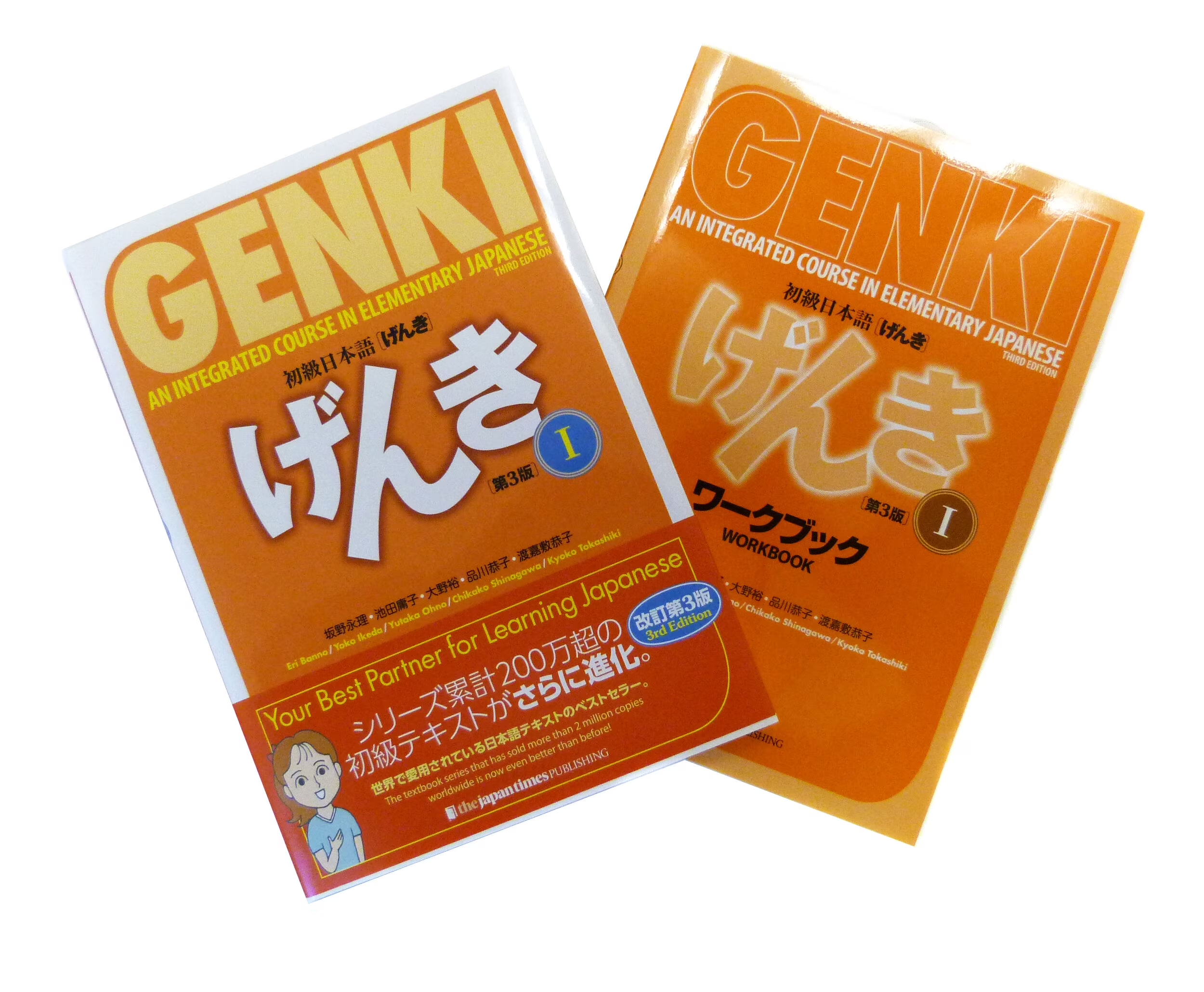
A structured resource builds this foundation far faster than anime can. If you prefer audio-based learning, JapanesePod101 builds exactly this foundation through short, leveled audio lessons with transcripts, which pairs well with an anime-focused study goal.
Stage 2: Start with easy anime, using Japanese subtitles
Once you have the foundation, switch your subtitle language. This is the step most people skip, and it’s the most important one.
Watching with English subtitles means your brain reads English and ignores the Japanese audio entirely. Your eyes are faster than your ears, and English is easier, so your brain takes the easy path every time.
Japanese subtitles force your brain to connect the audio to the written word. You’ll be slow at first. That’s normal. Stick with it.
Choose anime with clear, slow speech. The next section covers which titles work best.
Stage 3: Look up words you keep hearing
When a word appears repeatedly across several episodes and you still don’t know it, look it up and add it to your flashcard deck. This process is called sentence mining and it’s one of the most effective ways to build vocabulary from content you actually enjoy.
You don’t need to look up every unknown word. Just the ones that keep coming up.
The Anki flashcard app with the Kaishi 1.5k beginner deck is the standard starting point for vocabulary building before you’re ready to mine from anime. The deck covers the most common 1,500 words in frequency order. Once you finish it, your comprehension of everyday anime will be noticeably higher.
The Kaishi 1.5k beginner deck on Anki
How to set up FSRS Settings for Anki 2026
Stage 4: Gradually reduce English subtitles
There’s no fixed timeline for this. Most learners find they can go without English subtitles for certain types of content (familiar shows, simple slice-of-life dialogue, episodes they’ve already watched once) before they can drop them completely on new material.
A practical starting point: re-watch an episode you’ve already seen with English subs, but this time with Japanese subs only. If you can follow the plot, you’re making real progress. If you can’t, that tells you exactly what to focus on next.
The Best Anime for Beginners Learning Japanese
Not all anime is equal for learning. Action-heavy shows with fast, shouted dialogue are the hardest. Slice-of-life with everyday conversation is the most useful. Fantasy and sci-fi often introduce vocabulary that doesn’t appear anywhere else in the language.
Recommended for beginners:
- Shirokuma Cafe (しろくまカフェ): Slow, clear, friendly speech. A polar bear runs a cafe. The vocabulary is genuinely beginner-level and the episodes are short.
- Chi’s Sweet Home (チーズスイートホーム): Three-minute episodes following a kitten. Very simple Japanese. Hard to hate.
- Doraemon (ドラえもん): Designed for Japanese children, which means the vocabulary and speech speed are calibrated for someone learning language for the first time.
- Terrace House: (テラスハウス) Technically a reality show, not anime. But it features real people having real conversations in natural, modern Japanese. Much closer to how people actually speak than most scripted content.
- Studio Ghibli films: My Neighbor Totoro and Kiki’s Delivery Service are consistently recommended for clear pronunciation and everyday vocabulary. You probably already know the plots, which helps.
Avoid starting with: Death Note, Attack on Titan, Demon Slayer, anything with extensive fantasy terminology, and rapid-fire comedies like Gintama. These are excellent shows, but they aren’t beginner friendly from a language learning point of view.
Anime Japanese vs Real Japanese: What’s Different
This surprises a lot of learners and it’s worth addressing directly.
Anime speech patterns are often exaggerated. Villains speak with theatrical formality. Teenagers use slang that real teenagers find embarrassing. Samurai dramas use archaic language from centuries ago. Action heroes yell things at an intensity no real person sustains in conversation.
Some patterns you might pick up from anime that can cause friction in real-life Japanese:
- Using “ore” (俺) as “I”: Very masculine and rough in register. Fine among close male friends. Sounds abrasive in most other situations.
- Speech quirks like “dattebayo” (だってばよ): Naruto’s verbal tic. Not a real speech pattern that anyone uses. Well I guess you could use it, but it would be really weird.
- Heavy 敬語(けいご) (honorific speech) from period dramas: Extremely formal or archaic. Modern native speakers don’t use it in daily life.
None of this means you shouldn’t learn from anime. It means you should know that some of what you’re absorbing is performance, not natural speech. Balancing anime exposure with a structured resource keeps your Japanese grounded in how people actually talk.
Tools That Turn Anime Watching Into Actual Study
Watching passively builds listening exposure. These tools turn passive watching into active learning.
Language Reactor
A free browser extension for Chrome that works with Netflix and YouTube. It displays dual subtitles simultaneously (Japanese and English on screen at the same time), lets you click any word to see its definition, and saves clicked words to a flashcard export list. It’s the most practical tool for study-watching and the core features cost nothing.
Check out languagereactor.com here
Anki
The gold-standard flashcard app. Free on desktop and Android, paid on iOS. Start with the Kaishi 1.5k beginner deck to build your vocabulary base. Once you’re past the beginner deck, you can add words mined from anime directly into a personal deck. The combination of Anki for vocabulary and Language Reactor for mining is what most serious immersion learners use.
Jisho.org
A free Japanese-English dictionary that handles vocabulary, kanji, and full phrases. Bookmark it. You’ll use it constantly. Jisho means dictionary in Japanese, by the way.
Jisho is available here for free
Can you become fluent in Japanese just by watching anime?
No. There are no documented cases of someone reaching conversational fluency through anime alone with no other study. The learners who credit anime with their fluency were almost always using textbooks, flashcard apps, or tutors alongside their watching. Anime accelerates learning. It doesn’t replace the foundational work.
How long does it take to understand anime without subtitles?
Most learners reach partial comprehension of easy anime (slice-of-life, children’s shows) after one to two years of consistent study. Full comprehension of complex shows without subtitles typically takes three to five years. Yes, really. How much you study per day, which tools you use, and whether you’re actively mining vocabulary all affect this significantly.
Is anime Japanese different from real Japanese?
Yes, in some ways. Casual everyday speech is broadly similar, but anime exaggerates speech patterns, uses archaic or fictional vocabulary in certain genres, and features expressions that don’t appear in normal conversation. It’s useful for listening practice but shouldn’t be your only model for the language.
What is the best anime to learn Japanese as a complete beginner?
Shirokuma Cafe, Doraemon, and Chi’s Sweet Home are the most consistently recommended starting points. They use simple vocabulary, clear pronunciation, and slower-than-average speech. Ghibli films are also popular for the same reasons, with the added benefit that you likely already know the story.
Do I need to know hiragana before using anime to learn Japanese?
Yes, practically. Without hiragana you can’t read Japanese subtitles, which means you’re stuck reading English and bypassing the Japanese audio entirely. Learning hiragana first (one to two weeks of consistent daily practice) makes everything else work significantly better.
Should I use English or Japanese subtitles when studying with anime?
Japanese subtitles, once you know hiragana and katakana. English subtitles let your brain ignore the Japanese audio completely. One approach that works well for beginners: watch a new episode once with English subtitles to understand the plot, then re-watch with Japanese subtitles for the actual language study. The two-pass method is slower but considerably more effective.
If anime is what got you interested in Japanese, that’s a genuinely good reason to start learning. Motivation matters, and interest in the culture sustains effort when the novelty wears off. But treat anime as the reward that sits at the end of daily study, not as the study itself. Even 15 minutes of structured vocabulary practice each day, combined with regular anime watching in Japanese, will produce results that passive watching never will.