Source: 内閣広報室|Cabinet Public Affairs Office https://creativecommons.org/licenses/by/4.0/deed.en
CC BY 4.0
Is JLPT N3 Worth Taking? The Honest 2026 Answer
The question used to have a simple community consensus: yes, take N3 as a stepping stone, get the experience, see how JLPT exams work, then aim for N2.
That consensus was built before Japan rewrote its visa rules.
In October 2025, Japan introduced a Japanese language requirement at CEFR B2 level, equivalent to JLPT N2, for Business Manager visas. In early 2026, Japan’s Immigration Services Agency announced that the same N2 threshold is coming for the main white-collar work visa used by engineers and humanities specialists, effective mid-April 2026. Permanent residency requirements are moving in the same direction.
N3 appears in none of these thresholds.
That doesn’t automatically make JLPT N3 worthless. But it does make the question of whether it’s worth six months of your study time more complicated than it used to be, and more urgent to get right. Here’s a clear-eyed answer for each type of learner.
Table of Contents
What JLPT N3 Actually Certifies
JLPT N3 sits at the midpoint of the five-level scale. According to the Japan Foundation, N3 indicates the ability to understand Japanese encountered in everyday situations to a certain degree. In practice, it means:
- Comprehension of texts on familiar everyday topics at a manageable reading pace
- Following natural conversation (かいわ) conversation at near-natural speed on topics you already understand
- Knowledge of roughly 1,500 to 2,000 vocabulary (語彙, ごい) items and around 650 Kanji (漢字, かんじ)
The honest version of that list: N3 is functional literacy for controlled situations. You can read an NHK Web Easy article with effort. You can follow a slow conversation about a topic you already know in advance. You are not yet comfortable with the vocabulary load of business correspondence, nuanced grammar (文法, ぶんぽう) grammar, or the speed of natural native speech.
N3 is a real achievement. It represents several hundred hours of disciplined study and a genuine ability to operate in simple Japanese environments. The issue is not whether it reflects real ability. The issue is what it signals to employers, visa authorities, and anyone else whose opinion matters to your goals.
What Japan’s New Visa Laws Changed
This context matters specifically for learners who want to live or work in Japan, and it changed significantly in 2025 and 2026.
Business Manager Visa (October 2025): Japan now requires that either the applicant or a full-time employee holds Japanese language ability at CEFR B2 level, equivalent to JLPT N2 or a BJT score of 400+. This requirement took effect immediately with no transition period.
Engineers / Specialists in Humanities / International Services Visa (April 2026): Japan’s Immigration Services Agency announced that overseas applicants for roles requiring Japanese language skills will need to demonstrate CEFR B2 proficiency, again equivalent to JLPT N2. This is the primary work visa category covering white-collar professionals, IT workers, and engineers. It is the visa category most Japanese language learners are working toward if they want to work in Japan in a professional role.
Permanent Residency: Government panels are actively considering N2 as a language requirement for permanent residency applications. No law has passed at time of writing, but the direction of policy is consistent.
What this means for N3: In none of these frameworks does N3 appear as a qualifying threshold for professional white-collar roles. It has some role in the Specified Skilled Worker system, specifically the Employment for Skill Development program targeting blue-collar sectors, where N3 is relevant for certain advancement pathways. For most learners reading this article, that pathway is not the relevant one.
The employment reality outside of visa law has also hardened. The community consensus that “companies don’t value below N2” for white-collar roles is now supported by official government policy, not just anecdote.
Three Types of Learner, Three Different Answers
If you want to work in Japan in a professional capacity
Skip N3. Study toward N2.
This is the clearest case. N2 is now approaching a legal requirement for the work visa you need. N3 will not satisfy that requirement. Spending six months studying for N3 followed by another twelve months studying for N2 means eighteen months to reach the threshold a direct N2 pursuit could reach in twelve to fourteen.
The N3-to-N2 jump is hard. The vocabulary load roughly doubles. The grammar points become more nuanced. The listening section at N2 is considerably faster and more complex than at N3. These are real obstacles, but they are obstacles you will face regardless of whether you take N3 first. The question is whether you want to pay for an exam and dedicate months of focused study to a level that will not qualify you for your actual goal.
Some people argue that taking N3 first builds familiarity with the JLPT exam format, reducing anxiety on test day for N2. That is a legitimate point. But you can achieve the same outcome by sitting a mock N3 exam at home, spending the test fee and exam-day time on something more useful, and moving on with N2 preparation.
Verdict for career-focused learners: Not worth taking as a dedicated target. Study through N3 level material on your way to N2 without stopping to certify it.
If you’re studying Japanese for personal reasons
Here the answer is more nuanced and more honest: it depends entirely on what motivates you.
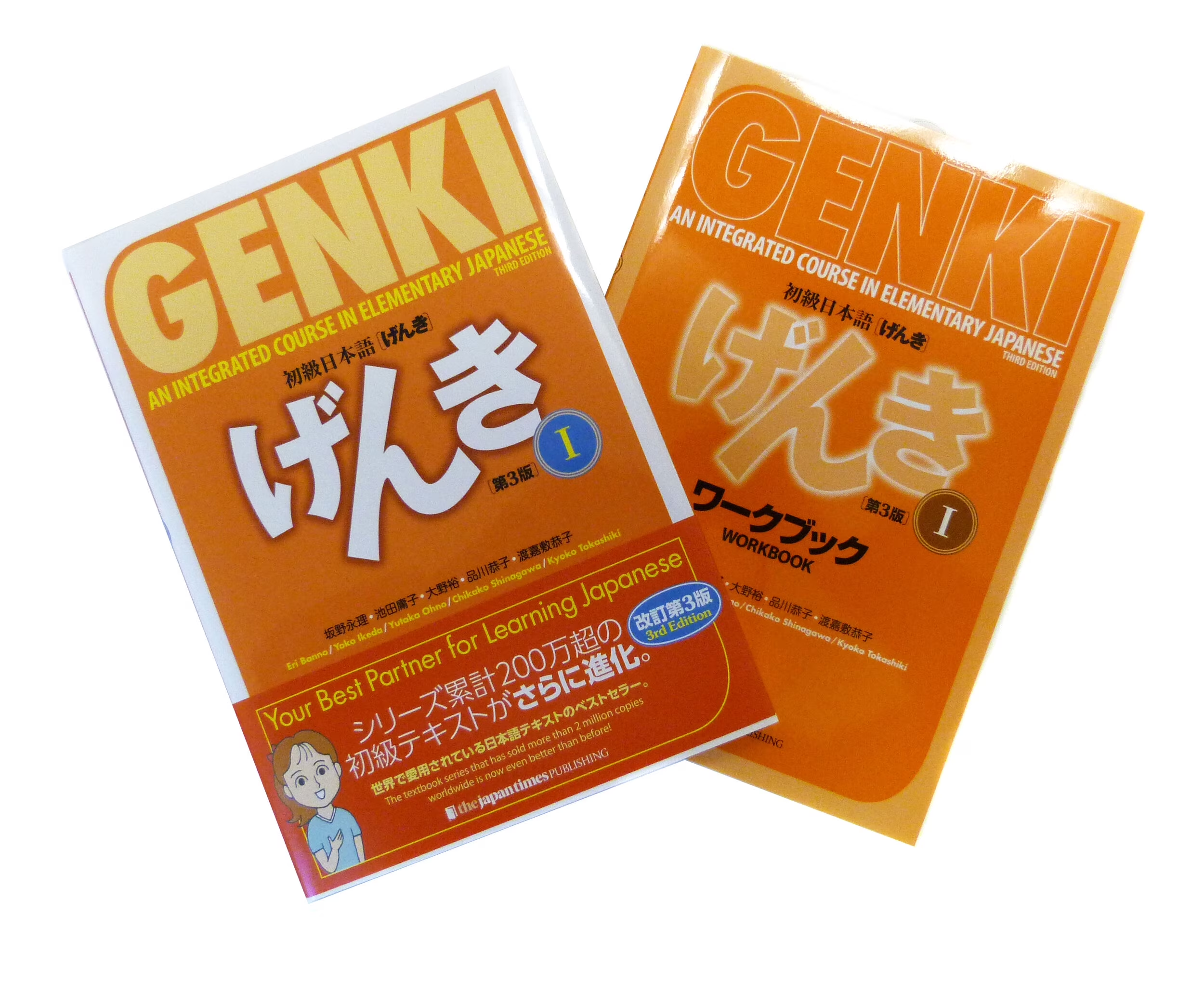
JLPT N3 is a meaningful milestone. Passing it demonstrates real, measurable progress. If you are the kind of learner who needs external validation to stay consistent, if finishing Genki 2 felt significant and you want another defined target before the longer N2 haul, then N3 is worth taking. Not because the certificate does anything, but because your consistency does, and if a concrete exam date is what keeps you consistent, that is a legitimate use of six months.
If you are self-motivated and track your own progress through reading ability, conversation fluency, or media comprehension, then N3 will not add anything you don’t already know about yourself. Your time is better spent on structured N2 preparation, immersion reading with Satori Reader, or regular speaking practice on italki.
Verdict for personal-motivation learners: Worth taking only if the exam structure keeps you studying. Not worth taking if you’re already consistent without it.
If you’re undecided or planning ahead
If you’re currently at N5 or mid-N4 level and trying to plan your trajectory, the most useful framing is this: N3 is not a destination, it’s a level. You will pass through it on your way to N2 regardless of whether you stop to certify it. Planning to sit the N3 exam is a scheduling question, not a study question.
The case for sitting it: the JLPT exam format is specific and not intuitive. The listening section in particular rewards people who have practiced the format, not just people who know Japanese. Experiencing the exam once before the higher-stakes N2 attempt is genuinely useful if you are prone to test anxiety or have never taken a formal language exam.
The case against: exam registration costs money. Preparing for exam conditions takes time. And there is a real psychological risk of sitting N3, passing, and then coasting on that result instead of pushing through to N2. Learner communities are full of people who passed N3 two or three years ago and are still “planning to study for N2.”
Verdict for planners: Consider sitting N3 once purely for exam experience, but do not dedicate a separate study period to it. Run N3 preparation as the foundation of your N2 study plan.
Should You Skip N3 and Aim for N2 Directly?
Yes, and it is more achievable than the difficulty gap makes it sound, provided you approach it correctly.
The jump from N4 to N2 bypassing a dedicated N3 exam period is a real time investment, typically twelve to eighteen months of consistent study depending on your hours per week and starting point. But the study content is not a leap. N3-level grammar and vocabulary are prerequisites for N2, not optional. You will study them either way. The difference is that you study them as a foundation rather than as a finishing line.
A practical path:
- Complete Tobira or Quartet 1 as your grammar structure resource for the N3-to-N2 range
- Use BunPro’s N3 and N2 grammar paths in parallel to keep grammar points active in SRS review
- Build vocabulary to 3,000 to 4,000 words through Anki sentence cards or jpdb.io, both of which can be targeted at N3 and N2 frequency lists specifically
- Start N2-specific exam preparation (Shin Kanzen Master N2 or Soumatome N2 series) six months before your target exam date
The learners who successfully skip from N4 to N2 are typically not doing anything more sophisticated than this. They are just not stopping.
What N3 Preparation Actually Looks Like
If you have decided to take N3 — for exam experience, for personal motivation, or because you are targeting the Specified Skilled Worker pathway where N3 has genuine relevance, here is what the preparation actually involves:
Time required: Most estimates for N4-to-N3 advancement run between 400 and 600 hours of total Japanese study, factoring in all the hours spent between starting Japanese and reaching N3 level. The incremental study from N4 to N3 specifically, assuming you are already at a solid N4 base, is typically three to six months at five to seven hours per week.
Grammar: N3 introduces 171 grammar points according to the Japan Foundation’s JLPT Can-do list. Most of these build directly on N4 patterns. BunPro’s N3 grammar path covers all of them with example sentences, SRS review, and notes on common mistakes. Working through it alongside a textbook is more efficient than a textbook alone, because BunPro surfaces the patterns you are weakest on rather than reviewing everything in chapter order.
Vocabulary: N3 requires roughly 1,500 to 2,000 words. If you finished Genki 2, you are at approximately 1,000 to 1,500. The gap is manageable with consistent Anki review at 10 to 15 new cards per day over three to four months.
Exam practice: The JLPT N3 listening section is faster than N4 and requires practiced comprehension under timed conditions. JLPT Sensei (external resource) offers free N3 practice questions. The Shin Kanzen Master N3 series provides the most thorough breakdown of each exam section, and the listening volume in that series is noticeably more useful than Soumatome at this level.
What N3 does not prepare you for: The gap between N3 and actual functional use of Japanese is large. Passing N3 does not mean you can hold a work meeting in Japanese, understand a drama episode without subtitles, or read a novel without constant dictionary use. If those are your goals, N3 is a waypoint, not a destination.
Is JLPT N3 recognized by Japanese employers?
Some, in limited roles. Small and medium-sized companies in hospitality, retail, and manufacturing sometimes accept N3 for positions that do not require complex written or spoken communication. For office roles, IT positions, and any professional white-collar work, the expectation is N2. Since Japan’s new visa guidelines for the main white-collar work visa are moving toward N2 as a minimum threshold, N3 is not sufficient for most employment-based visa applications.
How much harder is JLPT N2 compared to N3?
Significantly harder. The vocabulary load at N2 is roughly 3,000 to 6,000 words compared to 1,500 to 2,000 at N3. The grammar points become more abstract and context-dependent. The reading section uses longer, more complex passages with denser kanji. Most learners report that the N3-to-N2 transition takes considerably longer than the N4-to-N3 transition, partly because of the raw difficulty increase and partly because of the motivational slump that hits in the middle of intermediate study.
Is it possible to pass JLPT N3 without taking N4 first?
Yes. The JLPT does not require sequential certification. You can register for any level at any time. Many learners skip N4 entirely and go straight from beginner study to N3 registration. Whether that’s a wise use of exam fees depends on your current level.
Does N3 help with Japanese university applications or graduate school?
Sometimes. Requirements vary significantly by institution and program. Japanese universities admitting international students typically require N2 at minimum for programs taught in Japanese. Some programs in English may not require any JLPT certification. N3 is rarely specified as a threshold for university admission.
I passed N3 two years ago. Is it worth taking N2 now or is it too late?
It is not too late, but do not treat your N3 certification as a foundation you can build directly on without a review period. Two years of light study will have eroded some of the grammar and vocabulary patterns you relied on for N3. A BunPro N3 review pass alongside starting N2 preparation is a more effective starting point than jumping straight into N2 material.
What if I just want to enjoy Japanese media and have no interest in living in Japan?
Then visa law is irrelevant to your decision and the whole calculus changes. For pure personal enjoyment, N3 represents a level where Japanese media becomes meaningfully more accessible: you can follow simple slice-of-life anime dialogue more consistently, manga with standard vocabulary becomes readable with occasional lookups, and graded reader content at Level 3 to 4 opens up. If that milestone excites you and having the certificate would motivate you to reach it, taking N3 makes sense. If you would rather just read and watch more, and measure progress by what you understand rather than what you have certified, skip the exam entirely and put those months into Satori Reader or an immersion routine.
JLPT N3 in 2026 is not worthless, but it is not worth taking uncritically either. For career-focused learners with Japan in mind, the new visa landscape makes N2 the only level with real legal and professional weight. For personal learners, the question is whether the exam structure motivates you or merely delays you. For everyone else: study through N3-level material on your way to N2, and decide whether to certify it based on your exam experience goals, not based on what the certificate itself will do for you.
The six months it takes to prepare for N3 from a solid N4 base is also the first six months of a realistic N2 study plan. The only question is whether you want to pause in the middle and pay for a certificate that tells you what you already know.