WaniKani vs RTK for Kanji: An Honest Comparison
Most WaniKani vs RTK comparisons jump straight to features: price, pace, how many kanji each covers, which one Reddit recommends. That’s the wrong place to start.
WaniKani and RTK aren’t two different tools for the same job. They’re built on fundamentally different theories about what learning kanji actually means. Once you understand the philosophy behind each method, the practical comparison becomes a lot simpler, and the verdict by learner type becomes obvious.
Philosophy first. Practical details second. Verdict at the end.
Quick Answer: WaniKani teaches kanji meanings, readings, and vocabulary simultaneously in a managed platform. Expect 2–3 years to complete all 60 levels. Costs $299 lifetime or $9/month. RTK (full) teaches kanji meanings and visual patterns only. No readings, no vocabulary. Self-paced with Anki. Expect 3–7 months for Volume 1. Costs ~$25–35 for the book. RRTK (Recognition RTK) is a stripped-down free variant popular with immersion learners. Recognition only, no writing. Can finish 1,000 priority kanji in 4–6 weeks.
Choose WaniKani if you want a structured, managed path that builds reading ability from day one. Choose RTK if you want to front-load kanji recognition fast and layer readings on top independently. Choose RRTK if you’re doing immersion-based study (AJATT, Refold, sentence mining) and want a lightweight kanji foundation to complement that approach.
Table of Contents
1. The Philosophical Split: What Does “Knowing a Kanji” Mean?
Before comparing methods, it’s worth asking what you’re actually trying to achieve when you “learn kanji.”
There are two distinct goals that often get conflated:
Goal A: Recognizing the meaning of a kanji when you see it. Being able to look at 火 (ひ) and know it means fire, or look at 食 (しょく) and know it relates to eating. This is visual pattern recognition: mapping a character to a concept.
Goal B: Reading kanji in real words, with the correct pronunciation. Being able to look at 食事 (しょくじ) and know it means “a meal” and is read しょくじ. This requires connecting the character not just to a meaning but to a specific reading in a specific vocabulary context, and Japanese kanji have multiple readings depending on how they appear.
RTK is designed to accomplish Goal A efficiently and defer Goal B entirely. WaniKani is designed to accomplish both Goals A and B simultaneously, from the beginning.
That’s the split. Everything else follows from it.
2. What Is RTK?
Remembering the Kanji, usually shortened to RTK, is a book series by James Heisig, first published in 1977 and still in print. Volume 1 covers 2,200 kanji. It’s old-school, but it’s still around for a reason.
The RTK method works like this:
- Each kanji is assigned a single English keyword: one word that captures its core meaning. 火 gets “fire.” 食 gets “eat.” 愛 gets “love.”
- Each kanji is broken into component parts (called primitives in Heisig’s system), and a short story or mnemonic connects those primitives to the keyword.
- You drill the connection between keyword and character using spaced repetition software (SRS), which shows you material at calculated intervals to maximize long-term retention. Crucially, full RTK drills both directions: given the keyword, you produce the character from memory. This is what separates full RTK from the RRTK variant covered later.
What RTK deliberately does not teach you: readings.
The on’yomi (おんよみ) and kun’yomi (くんよみ) of each character are not covered in Volume 1 at all. Heisig’s argument is that learning meaning and form first, separately from readings, allows the visual patterns to consolidate before you add the complexity of multiple pronunciations per character.
RTK is a book. The actual SRS drilling is typically done with Anki, free open-source flashcard software, using community-created RTK decks. The book provides the framework and stories; Anki provides the review schedule.
3. What Is WaniKani?
WaniKani is a web-based SRS application built by Tofugu, launched in 2012. It covers 2,000 kanji and approximately 6,000 vocabulary words.
The WaniKani method works like this:
- Each kanji is introduced through its component radicals: simplified building blocks with their own mnemonics.
- The radical mnemonics feed into a kanji mnemonic that connects the character to both its meaning and its primary reading simultaneously.
- Vocabulary words using that kanji are introduced immediately after, reinforcing the reading in real context.
- Everything is reviewed on a fixed SRS schedule managed by the platform.
WaniKani’s learning order is entirely predetermined. Kanji are introduced in an order Tofugu designed based on what builds most efficiently. Not in JLPT (日本語能力試験, にほんごのうりょくしけん) order, not in textbook order, not by frequency. You follow the path as it’s laid out.
WaniKani has 60 levels. Progressing through all of them at maximum pace takes twelve to eighteen months. The average learner, accounting for real life, takes two to three years to reach Level 60.
4. The Core Difference in Practice
The philosophical split plays out like this in reality:
An RTK learner who finishes Volume 1 can look at almost any kanji and recall its English keyword meaning. They can write kanji from memory when given the keyword. They cannot yet read those kanji in words. They have no systematic knowledge of readings and haven’t learned any vocabulary through the process. RTK graduates typically describe being able to “see through” kanji: they can parse the visual structure of almost any character, which makes the next stage of learning readings and vocabulary feel more manageable.
A WaniKani learner at Level 30 knows roughly 1,000 kanji with both meanings and primary readings, plus around 3,000 vocabulary words. They can read a significant portion of everyday Japanese text. They’ve been building reading ability from the start, not deferring it. The trade-off: they’re halfway through a multi-year program with 1,000 kanji still ahead of them.
Neither picture is wrong. They’re different stages on different paths.
5. Time, Cost, and Commitment
RTK
Time to complete Volume 1: Highly variable. The fastest documented runs, learners doing 20 to 30 new kanji per day with immediate Anki review, finish in five to eight weeks. A sustainable pace of 10 new kanji per day takes roughly seven months. There’s no platform enforcing your pace; you move as fast or as slowly as you choose.
Cost: The book costs approximately $25 to $35 on Amazon. Anki, which you need for SRS drilling, is free on desktop and Android. The iOS version is a one-time $25 purchase.
Review burden after completion: RTK’s hidden cost. Once you’ve drilled 2,200 kanji into Anki, you have 2,200 cards in rotation. Daily reviews at steady state run 100 to 200 cards per day. If you’re using FSRS, Anki’s modern scheduling algorithm that replaced the older SM-2 default, your review load will be meaningfully lower than older guides suggest. But missing days still compounds fast regardless of which algorithm you’re using. RTK is not a one-and-done method; it requires ongoing maintenance.
WaniKani
Time to complete: Twelve to eighteen months at maximum pace. Two to three years at a realistic everyday pace. There’s a hard speed limit built into the platform; you cannot progress faster than the review schedule allows.
Cost: WaniKani offers a free trial covering the first three levels. Beyond that: $9/month, $89/year, or a one-time lifetime purchase of $299. The lifetime option is the best value for anyone planning to go past Level 20.
Review burden at steady state: WaniKani manages your review schedule automatically. The trade-off is that letting reviews pile up has the same compounding effect as Anki: miss two days and you return to a queue that takes significantly longer to clear. That’s the nature of SRS regardless of which system you use.
6. Self-Study Suitability
Both methods are designed for self-study, but they suit different self-study personalities.
RTK suits self-studiers who:
- Want maximum control over their own pace and learning order
- Are comfortable managing Anki decks and review settings themselves
- Find motivation in visible daily progress that they control
- Are willing to integrate RTK into their broader Japanese study independently. The book gives you no vocabulary, no readings, and no grammar
WaniKani suits self-studiers who:
- Want a structured, managed system with no setup decisions
- Find motivation in a clear level progression with defined milestones
- Prefer building reading ability from day one rather than deferring it
- Are comfortable paying a subscription or making an upfront investment for a system that handles the logistics for them
7. What Each Method Doesn’t Do
RTK does not teach you:
- Any kanji readings: not on’yomi, not kun’yomi
- Any vocabulary words
- Any grammar
- How to read Japanese text
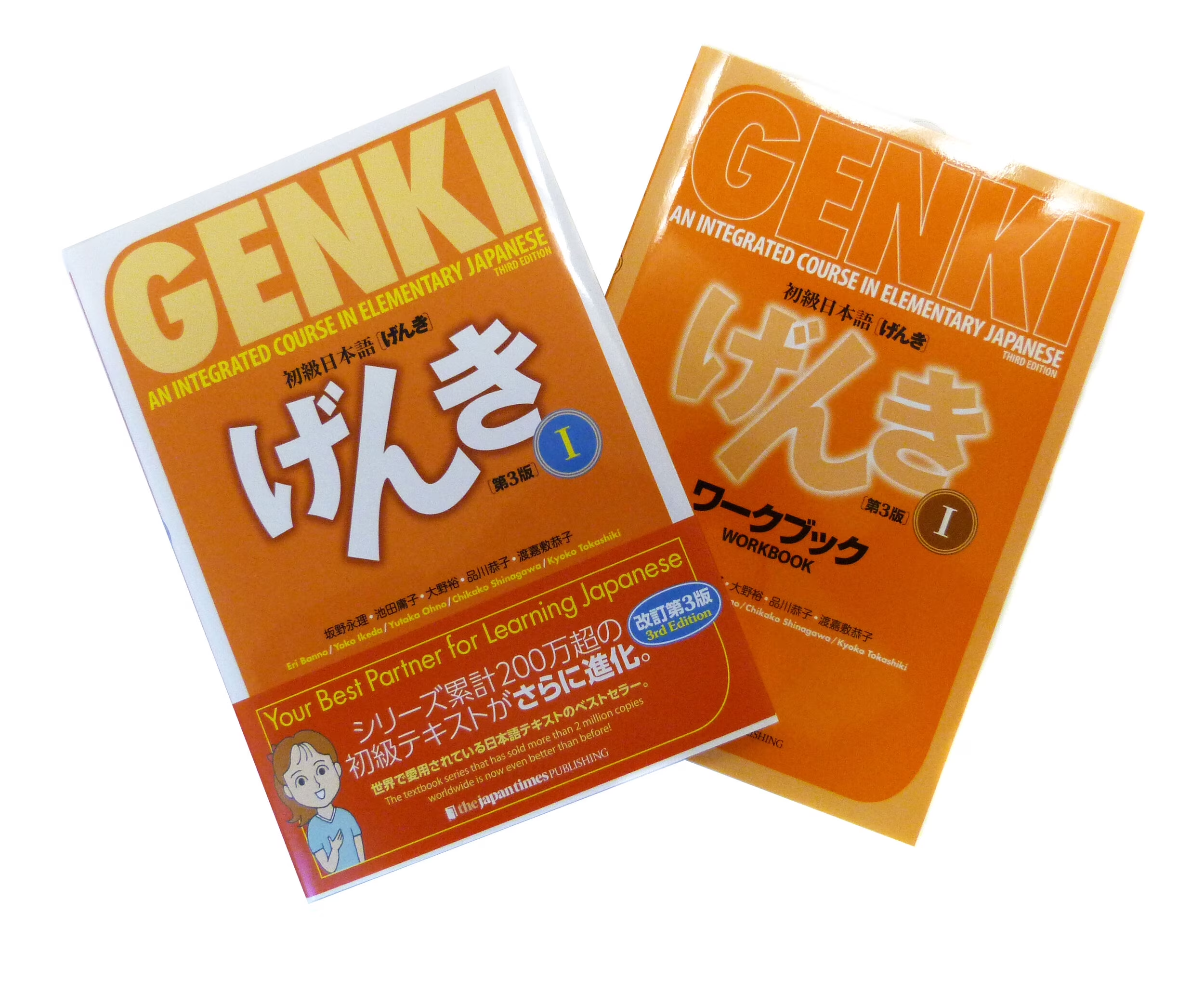
RTK is a foundation specifically for recognizing and remembering kanji shapes and meanings. You still need a completely separate system for readings and vocabulary. Most RTK learners pair the book with a grammar resource like Genki or Tae Kim and move to a vocabulary Anki deck like Kaishi 1.5k after completing it.
WaniKani does not teach you:
- Grammar
- Handwriting: WaniKani is entirely recognition-based; you never write a character by hand
- Every kanji reading, since it teaches the most common reading per kanji in context rather than the full reading set
WaniKani handles kanji and vocabulary well but isn’t a complete Japanese study system. Most WaniKani learners pair it with a grammar resource like Genki, Tae Kim, or BunPro.
Neither method is a complete solution on its own. The question isn’t which one is enough. It’s which one fits your broader study approach.
8. The Anki Option: RTK Without the Book
Worth mentioning separately because it changes the cost calculation.
Many learners use what’s informally called the “lazy kanji” approach: a pre-built Anki deck that covers RTK’s kanji in Heisig’s order, with his keywords and community-contributed mnemonics, without purchasing the book. The deck is free to download from AnkiWeb.
This gives you most of RTK’s benefits at zero cost. The trade-off is that Heisig’s full mnemonic stories aren’t included. You get the keyword and character with shorter community mnemonics rather than the book’s detailed ones. For learners who create their own stories anyway, which many find more effective, this isn’t a meaningful loss.
If you’re considering RTK but unsure about committing, starting with a free Anki RTK deck is a legitimate way to test the method before spending anything.
9. What Is RRTK (Recognition RTK)?
RRTK stands for Recognition RTK. It’s a stripped-down variant of the RTK method that’s become increasingly common in the immersion learning community, particularly among learners following AJATT, Refold, or Mass Immersion Approach (MIA) frameworks.
Here’s the core difference from full RTK:
- Full RTK drills both directions: given the English keyword, you write the kanji from memory. This builds both recognition and production.
- RRTK drills one direction only: given the kanji, you recall the keyword. No writing. Recognition only.
The most commonly used RRTK deck covers around 1,000 to 1,250 kanji (the highest-frequency characters) rather than the full 2,200 in Heisig’s Volume 1. At 20 to 30 new cards per day with no writing component, many learners finish it in four to six weeks.
Why the immersion community uses it
Immersion learners are typically building vocabulary through sentence mining and native content from early on. In that context, learning to write kanji from memory is low priority. They’re reading and listening, not handwriting. RRTK gives them just enough of a kanji scaffold to make sentence mining feel less overwhelming, without the full time commitment of either RTK or WaniKani.
The controversy: Heisig explicitly warned against this
This isn’t a minor footnote. Heisig addresses recognition-only drilling in RTK itself and argues against it on at least two separate occasions in the book. His position is that drilling keyword-to-character (production) is what makes the patterns stick. Recognition-only drilling, in his view, creates weaker, shallower memory traces.
There’s genuine community disagreement on this. Many RRTK completers report that it did exactly what they needed. Others find the retention poor at longer intervals, consistent with what Heisig predicted.
Where RRTK fits in the comparison
RRTK is faster than both full RTK and WaniKani as a kanji foundation. It’s also shallower. It makes the most sense if you’re committed to an immersion-first approach and plan to acquire readings through vocabulary exposure rather than systematic study. It doesn’t make sense if you want to build strong, durable kanji memory or if you have any interest in handwriting.
If you’re not doing immersion-based study, full RTK or WaniKani will serve you better than RRTK.
10. Side-by-Side Summary
| RTK (Full) | WaniKani | RRTK | |
|---|---|---|---|
| Method | Meaning + writing via mnemonics | Meaning + reading + vocab via SRS | Recognition only via Anki deck |
| Teaches readings? | No. Deferred to later study | Yes. Primary readings taught throughout | No. Deferred to immersion |
| Teaches vocabulary? | No | Yes. ~6,000 words | No |
| Teaches handwriting? | Yes. Drilling requires writing | No. Recognition only | No |
| Kanji covered | 2,200 (Vol. 1) | 2,000 | ~1,000–1,250 (priority kanji) |
| Learning order | Heisig’s order (by visual complexity) | Tofugu’s order (by radical building blocks) | Frequency-based |
| Pace control | Fully self-determined | Platform-controlled (hard speed limit) | Fully self-determined |
| Time to complete | 6 weeks – 7 months | 12 months minimum; 2–3 years typical | 4–6 weeks |
| Cost | ~$25–35 (book) + free Anki | Free trial; $9/mo, $89/yr, or $299 lifetime | Free |
| Setup required | Some. Anki deck configuration | None. Platform handles everything | Minimal. Download deck, start reviewing |
| Best for | Self-directed learners who want durable kanji + handwriting | Beginners who want a managed, all-in-one system | Immersion learners who want a fast, lightweight kanji scaffold |
11. Verdict: Which One Should You Choose?
Choose RTK if:
- You want to get through kanji recognition as fast as possible and then layer readings on top through vocabulary study
- You’re comfortable building and maintaining your own Anki setup
- You’re pairing your kanji study with a grammar textbook from day one and don’t need your kanji system to also teach you words
- Handwriting matters to you. RTK is the only method of the three that builds it
Choose WaniKani if:
- You want a managed, structured system where someone else has made all the decisions about order, pace, and review scheduling
- You want to build reading ability as you go rather than front-loading recognition and deferring everything else
- You’re a beginner who isn’t yet sure how to build a self-study system from scratch
- You don’t mind the subscription cost in exchange for not having to think about the logistics
Choose RRTK if:
- You’re following an immersion-based method (AJATT, Refold, MIA, sentence mining from native content)
- You want the fastest possible kanji scaffold to make reading native material less overwhelming
- You’re willing to accept shallower initial retention in exchange for speed
- You have no interest in handwriting
The case where none of these is ideal:
If you’re studying Japanese primarily through immersion and already sentence mining from early on, you may find that even RRTK is more overhead than you need. Some immersion learners skip dedicated kanji study entirely and let vocabulary acquisition build their kanji knowledge organically. A frequency-ordered vocabulary tool like jpdb.io supports this approach well.
Read our WaniKani vs jpdb.io Comparison
Is RTK still worth doing in 2026?
Yes, for the right learner. Separating kanji meaning from readings reduces cognitive load in the early stages, and that holds true regardless of how old the book is. The method has aged better than many alternatives because it addresses a genuine structural challenge of kanji acquisition rather than just drilling characters by frequency.
Can I do RTK and WaniKani at the same time?
Don’t. Both systems cover overlapping kanji in different orders with different mnemonics. Running both simultaneously means maintaining two large SRS review queues with competing memory hooks for the same characters. Pick one.
Does WaniKani teach all the kanji I need?
WaniKani covers 2,000 kanji, which gets you to roughly the joyo kanji (常用漢字, じょうようかんじ) standard, the set considered necessary for functional adult literacy in Japanese. That’s sufficient for the vast majority of learners’ goals.
How long does RTK actually take at a realistic pace?
At 10 new kanji per day, a pace most working adults can sustain without burnout, RTK Volume 1 takes approximately seven months. At 20 per day, roughly three and a half months. Both assume you’re keeping up with Anki reviews daily; falling behind on reviews extends the timeline significantly.
What is the difference between RTK and RRTK?
Full RTK drills kanji production: given an English keyword, you write the character from memory. RRTK drills recognition only: given the character, you recall the keyword. RRTK covers fewer kanji (roughly 1,000 to 1,250 vs. 2,200), costs nothing, and can be completed in weeks rather than months. The trade-off is shallower retention and no handwriting ability. Heisig himself argued against recognition-only drilling in the book, though many learners report RRTK working well for their specific use case.
What do I do after finishing RTK?
Readings and vocabulary are the entire next stage. Most RTK graduates move to a vocabulary Anki deck like Kaishi 1.5k, which teaches common words with their readings in context, alongside continuing whatever grammar study they’ve been running in parallel. The kanji recognition foundation from RTK makes absorbing new readings through vocabulary study noticeably faster than it would be starting from scratch. What to Do After Finishing Genki 1?
Is WaniKani worth paying for when Anki is free?
That depends on what you’re paying for. Anki is free and powerful, but it requires you to make decisions about decks, settings, and review management. WaniKani makes all of those decisions for you and builds the curriculum around kanji specifically. If the main thing stopping you from doing RTK with Anki is that you don’t want to configure anything, WaniKani’s pricing is the cost of not having to.
The WaniKani vs RTK question doesn’t have a universal answer because the two methods, RRTK included, are each solving a different version of the same problem. WaniKani builds reading ability from day one, slowly and systematically. Full RTK builds a visual and written foundation fast, then hands the reading work off to whatever comes next. RRTK builds the minimum viable kanji scaffold as quickly as possible for learners whose main study method is immersion.
All three work. The one that works for you is the one whose trade-offs you can actually live with over several months, not the one that sounds best in a Reddit thread.