How Long Does It Take to Finish Genki 1?
Most self-studiers finish Genki 1 in three to nine months. University students using it in a classroom course typically cover it in one academic semester, roughly four to five months. Some learners take twelve months or longer, usually because life interrupts their schedule or they slow down significantly in the later chapters.
The reason the range is so wide is not that some people are smarter or more talented at Japanese. It comes down almost entirely to one variable: how many hours per week you actually study, consistently, over time.
If you are trying to plan your schedule before starting Genki 1, or you are partway through and wondering if your pace is normal, this breakdown will give you a realistic picture.
Table of Contents
What Genki 1 Actually Contains
Before getting into timelines, it helps to know what you are actually committing to.
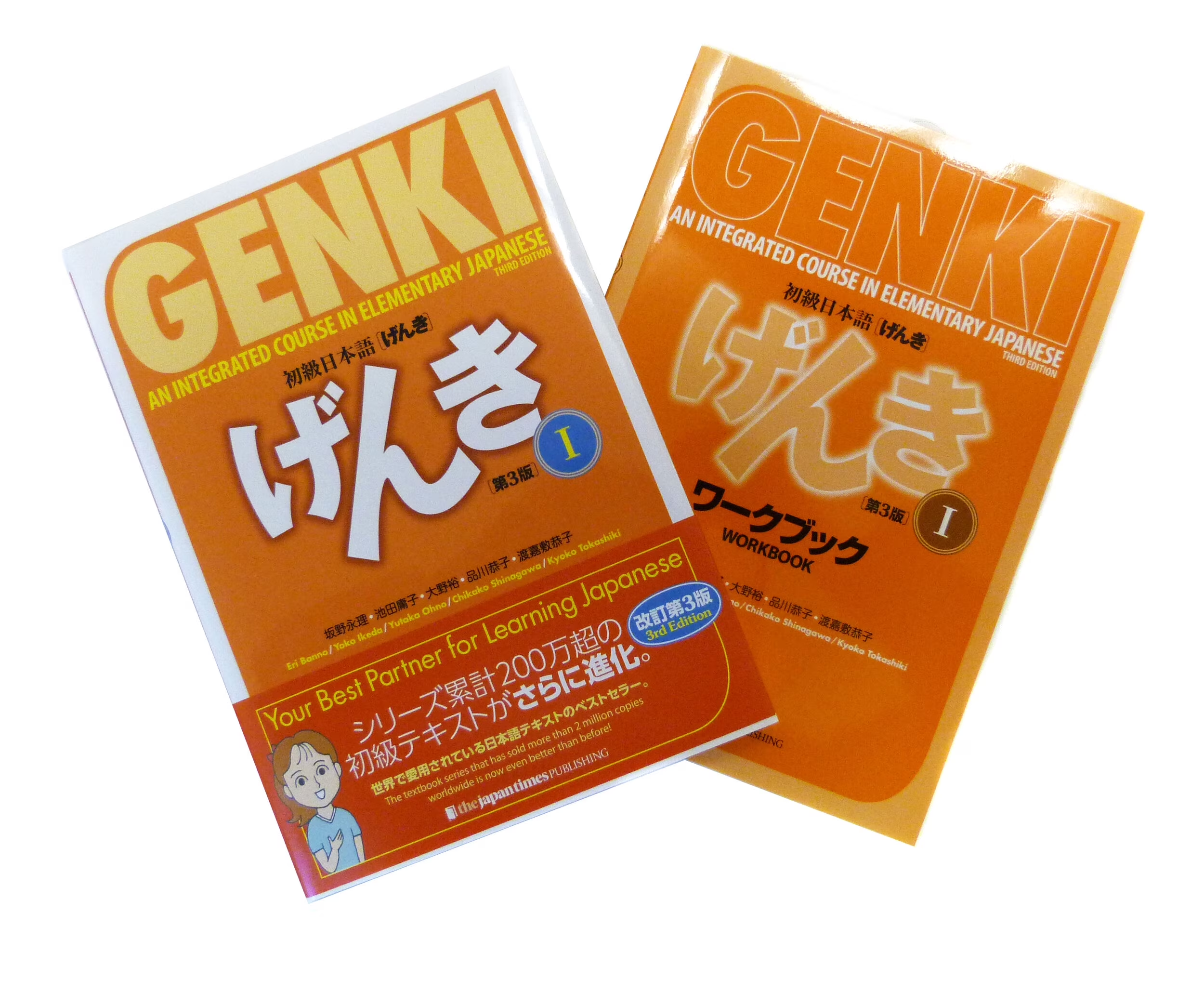
Genki 1 has twelve main chapters, each built around a grammar point, a reading section, a listening section, and a vocabulary list. There are also three introductory lessons at the front of the book covering hiragana and katakana, the two Japanese phonetic alphabets you need before anything else works.
Each chapter introduces around 80 to 100 new Japanese words, three to five grammar patterns, and a set of kanji (Chinese characters used in written Japanese) that you are expected to learn to recognize and write. By the end of the book, you will have covered roughly 1,100 vocabulary items and 170 kanji.
The companion workbook is sold separately. It is not optional if you are serious about retaining what you study. The workbook exercises reinforce each chapter’s grammar through writing practice, which is how patterns actually move from “I recognize this” to “I can use this.” Budget time for it in your schedule.
Genki 1 also comes with online audio resources. The listening sections throughout the book require these. Factor in download or streaming time, especially if your internet access is inconsistent.
How Long Genki 1 Takes by Hours Per Week
The table below gives realistic completion estimates based on weekly study time. These assume you are working through the main textbook and the workbook together, not skipping exercises, and doing some form of vocabulary review between sessions.
| Weekly Study Time | Estimated Completion Time |
|---|---|
| 2 hours per week | 12 to 18 months |
| 3 to 4 hours per week | 8 to 12 months |
| 5 to 6 hours per week | 5 to 8 months |
| 7 to 10 hours per week | 3 to 5 months |
| 10+ hours per week | 2 to 3 months |
A few caveats:
Hiragana and katakana add time at the start. If you are learning these from scratch before touching Chapter 1, add two to four weeks to your total. Most learners spend a few focused days on hiragana, a few more on katakana, and then move on. But “moving on” before you can read them automatically without sounding out each character will slow you down inside every subsequent chapter.
The workbook takes roughly as long as the main textbook. Many completion estimates you will find in Reddit threads are based on just reading through the main book. If your goal is actually learning Japanese rather than finishing a book, the workbook exercises are not optional. Factor them in.
Vocabulary review time is not counted in the textbook. Genki 1 expects you to memorize new words each chapter, but the textbook itself does not have a built-in review system. Most learners who successfully retain the vocabulary use a separate flashcard tool alongside the book. That adds 10 to 20 minutes of daily review time to your schedule. More on this below.
Self-Study vs Classroom: Why the Timelines Differ
Genki 1 was written as a university classroom textbook. This shapes how the book is structured and how long it takes depending on how you are using it.
In a university setting, a single semester typically covers Genki 1 across 15 weeks of instruction. That works out to roughly two chapters per month, with a teacher guiding you through the grammar, correcting your pronunciation in speaking exercises, and providing deadlines that create consistent study pressure.
Self-studiers typically take longer, for a few reasons.
First, there is no external deadline. Without a test on Friday, it is easy to let a chapter stretch from one week to three. Slow progress is not inherently a problem, but chapters that drag on too long mean vocabulary from the start of the chapter starts fading before you have finished reviewing it.
Second, the speaking and listening sections in Genki are designed for classroom pairs. If you are studying alone, you either skip those sections, adapt them as solo shadowing practice, or find a language exchange partner to work through them with. All three approaches are workable, but each requires more initiative than a classroom provides.
Third, grammar confusion without a teacher to ask is slower to resolve. You will spend time on forums or searching for explanations that a teacher would clear up in two minutes. This is not a reason to avoid self-study, but it is a real time cost.
If you are self-studying, a realistic and sustainable pace is one chapter every two to three weeks. That lands you at around six to nine months for the full twelve chapters. You may be faster than that. If you go slower, that is also normal and not a sign that something is wrong.
What Slows People Down Inside Genki 1
Certain chapters and topics cause most learners to slow down noticeably. Knowing about them in advance means you can plan for them rather than being surprised when you hit a wall.
The hiragana and katakana foundation
The introductory lessons in Genki 1 cover hiragana and katakana. These are the two phonetic writing systems in Japanese. Hiragana has 46 basic characters. Katakana also has 46, representing the same sounds but used for different purposes, mainly foreign loanwords and emphasis.
Most learners can get through hiragana in a week of focused practice. Katakana typically takes a little longer because it comes second and the characters are less visually distinct from each other. The problem is that many learners move on before they can read these automatically. Every subsequent chapter requires reading hiragana and katakana fluently. If you are still sounding out characters one by one, the reading load of Chapter 1 onwards will feel much heavier than it needs to.
Spend the time here. Automatic recognition of both systems before Chapter 1 makes every subsequent chapter measurably faster.
Chapters 4 to 6: the first grammar complexity spike
The first three chapters of Genki 1 introduce vocabulary and simple sentence patterns. Chapters 4 through 6 introduce the first genuinely unfamiliar grammar concepts for English speakers: particle usage (the small words like は, が, を, and に that mark the function of words in a sentence), verb conjugation patterns, and adjective types.
This is where the first wave of learner drop-off happens. The material is not impossible, but it requires a shift from memorizing words to understanding how Japanese sentences are actually built. Expect to spend more time per chapter here and to re-read grammar explanations more than once.
Kanji accumulation in chapters 7 to 12
Each chapter introduces a set of kanji characters to learn. By the final chapters, the accumulated list is substantial. Learners who have not been keeping up with kanji review throughout the book tend to hit a wall in the second half when the reading sections start using kanji from earlier chapters and they have forgotten them.
The most effective approach is to review each chapter’s kanji as you go rather than trying to catch up later. Spaced repetition software (SRS), a type of flashcard system that shows you cards just before you are likely to forget them, is the most efficient tool for this. Anki is the most widely used free option.
Vocabulary attrition between sessions
Genki 1 introduces a lot of new vocabulary every chapter. Without active review between sessions, a significant portion fades within a week. Learners who rely on re-reading the vocabulary list at the start of each study session tend to feel like they are always relearning rather than progressing.
The fix is a dedicated vocabulary review tool outside the textbook. The Kaishi 1.5k Anki deck is built specifically for Japanese beginners and covers the most common vocabulary at roughly the same level as Genki 1. Using it alongside the textbook, spending 10 to 15 minutes per day on flashcard review, is one of the most reliable ways to prevent vocabulary from fading between chapters. The deck is free on AnkiWeb.
You can download the Kaishi 1.5k Anki deck here
A Chapter-by-Chapter Pacing Guide
The schedule below is built for a self-studier aiming to finish Genki 1 in six months at roughly five to six hours per week. Adjust the per-chapter time up or down based on your actual weekly availability.
| Section | Target Time | Notes |
|---|---|---|
| Introductory Lessons (Hiragana + Katakana) | 2 to 4 weeks | Do not rush. Automatic reading is the foundation. |
| Chapters 1 to 3 | 1 to 2 weeks each | Lighter grammar load; focus on vocabulary retention. |
| Chapters 4 to 6 | 2 weeks each | First grammar complexity spike. Slow down here intentionally. |
| Chapters 7 to 9 | 1.5 to 2 weeks each | Kanji load increases. Keep up with daily kanji review. |
| Chapters 10 to 12 | 2 weeks each | Grammar becomes more nuanced. Re-read explanations as needed. |
Total at this pace: roughly 22 to 28 weeks, or five to seven months.
If you fall behind this pace, do not try to compress future chapters to catch up. Each chapter depends on the previous ones. Rushing chapters 4 through 6 to get back on schedule will make chapters 7 through 12 significantly harder.
What to Do When You Finish
Finishing Genki 1 is a real milestone. Most learners who pick up a Japanese textbook do not get this far.
But finishing Genki 1 does not mean you can read native Japanese text, hold an unscripted conversation, or understand a Japanese speaker at natural speed. Those abilities come later. Genki 1 builds the grammatical foundation. Everything useful you do with Japanese gets built on top of it.
The clearest next step for most learners is Genki 2. It picks up directly where Genki 1 ends, covers the remaining grammar you need for JLPT N4 (the second-lowest level of the Japanese Language Proficiency Test, a standardized exam widely used to measure Japanese ability), and uses the same structure and format you are already familiar with.
If Genki 1 felt too slow or too classroom-oriented for your learning style, some learners switch to Tobira or Quartet for the intermediate stage. Both are designed for learners who have finished a beginner textbook and are ready for more complex material. The jump in difficulty is real, so most people find moving to Genki 2 first is the more reliable path.
How about you check out our guide for Genki 1 if you’re curious?
Is it normal to take more than a year to finish Genki 1?
Yes. Life happens. Work, school, travel, and inconsistent motivation all slow people down. A year is longer than most structured timelines suggest, but it is not unusual for learners studying two to three hours per week with irregular schedules. The more relevant question is whether you are still making progress, even slow progress. Finishing slowly is far better than stopping.
Do I need to complete every exercise in Genki 1?
Not necessarily every single one, but close to it. The grammar section exercises and workbook writing drills are the core of the learning process. Skipping the speaking exercises when studying alone is understandable. Skipping the workbook consistently is not recommended since those exercises are where grammar patterns actually get consolidated.
Should I use a tutor to get through Genki 1 faster?
A tutor helps a lot, particularly for the speaking sections and grammar confusion. Even one 30-minute session per week with a patient tutor speeds up the chapters where grammar concepts feel unclear. italki has tutors who specialize specifically in guiding beginners through Genki. The cost of one session per week is often worth more in time saved than the session itself costs.
Can I use Genki 1 and Duolingo at the same time?
Yes, though they do not cover the same material in the same order. Duolingo Japanese covers hiragana and katakana well as a starting point, and its short daily lessons help build the habit of studying every day. It is not a substitute for Genki 1’s grammar depth, but using both together is not a problem. Treat Duolingo as a warm-up tool and Genki 1 as the main event.
How many hours total does Genki 1 require?
A rough estimate is 150 to 250 hours of active study, including the workbook. This aligns with the FSI (Foreign Service Institute) estimate that Japanese learners need around 2,200 total hours to reach professional working proficiency. Genki 1 covers roughly the first 10 percent of that overall journey, which should give you a realistic sense of the commitment involved and set appropriate expectations for where you will be when you finish.
I have been stuck on the same chapter for two months. What should I do?
First, check whether you actually understand the grammar in that chapter or whether you are waiting to fully understand it before moving on. Most learners get stuck waiting for a level of clarity that only comes from exposure over time, not from re-reading the same explanation. If you understand the grammar well enough to complete the exercises with occasional mistakes, move forward. You will reinforce the patterns in later chapters. Staying stuck on one chapter for months rarely produces better retention than moving on with a review plan.
Finishing Genki 1 takes most self-studiers somewhere between three and nine months. The timeline is wide because the variable that matters most, consistent weekly hours, varies enormously from person to person. Set a realistic schedule, keep your vocabulary reviews going between sessions, and do not skip the workbook. The learners who finish Genki 1 are not the ones who started fastest. They are the ones who kept a steady pace long enough to reach Chapter 12.
Just finished? Check out What to Do After Finishing Genki 1 if you’re curious.
Wondering about which is the best overall textbook for Japanese? Check out our article about the best Japanese textbook for more info!